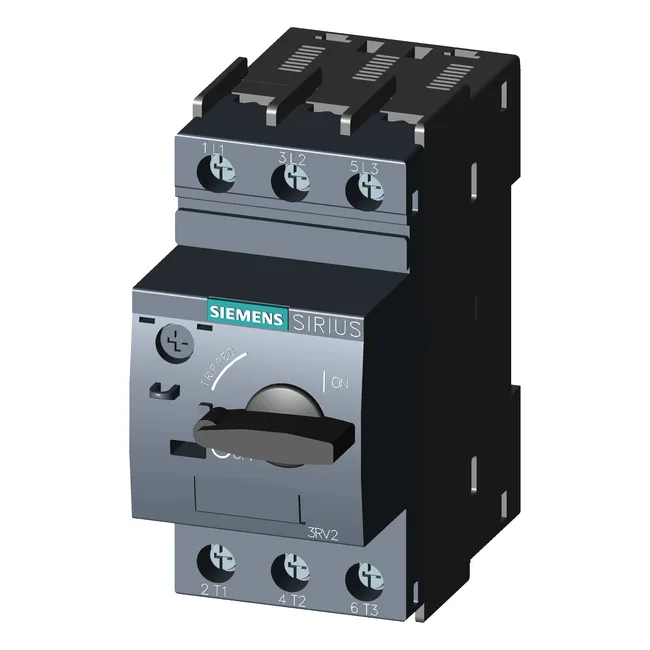
What it is and what it does
The Siemens SIRIUS 3RV2011-1DA10-ZW96 is a motor protection circuit breaker designed for motor protection, with a Trip Class 10 characteristic that clears overloads before the motor winding exceeds its thermal limit — the standard for standard-duty induction motors starting under load. It mounts via screw and snap-on onto 35 mm standard mounting rail per DIN EN 60715, in any mounting position, making it a direct fit for a standard panel enclosure without extra bracketry. Phase failure detection is built in, so a lost phase on the line side trips the breaker and protects the motor from single-phasing — no separate phase monitor needed. Ground fault detection is not included, so if that's a requirement, you'll need an external ground-fault relay or a different breaker variant.
Key ratings and what they mean for fit
The interrupting ratings are the headline: 100 kA at 240 V, 400 V, and 500 V, and 10 kA at 690 V. That 100 kA SCCR at 400 V means this breaker can safely clear a fault up to 100 kA without rupturing or cascading upstream — critical for panels with high available fault current from a large transformer. Fuse backup ratings are specified: gL/gG 25 A at 400 V, 32 A at 500 V, and 25 A at 690 V. If you're coordinating with upstream fuses, those are the maximum sizes the breaker is tested with. Operating temperature range is -20 to +60 °C, with temperature compensation over that same span, so the thermal trip curve stays accurate in a hot panel near a drive or in an unheated enclosure. Main circuit connections are screw-type terminals accepting 2x (0.75 to 2.5 mm²) solid or stranded, or 2x 4 mm² — standard for panel wiring with ferrule or direct termination.
Dimensions and panel integration
The breaker measures 45 mm wide, 97 mm deep, and 97 mm high — a compact footprint that fits a standard 45 mm slot on the DIN rail, leaving room for adjacent devices. Clearance requirements: 50 mm upwards and downwards, 30 mm at the sides, and 0 mm forwards and backwards. That 0 mm backwards means it can sit flush against a back panel or enclosure wall — no extra breathing space needed behind the rail.
