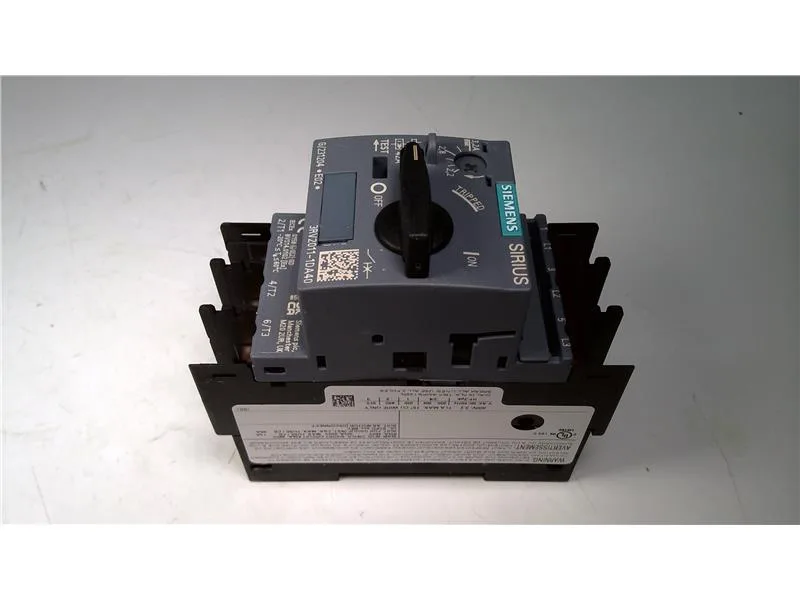
What it is and what it does
The Siemens 3RV2011-1DA40 is a SIRIUS motor protection circuit breaker designed to protect motor branch circuits against overload and short-circuit. It trips in CLASS 10, meaning it clears an overload within 10 seconds at 7.2× the thermal setting — fast enough to protect standard induction motors during a stalled-rotor event. The breaker is rated for a rated value of 20 to 690 V and delivers a short-circuit breaking capacity of 100 kA at 400 V, which safely interrupts fault currents up to that level without upstream fuses needing to clear first. Phase failure detection is built in, so a lost phase on the line side trips the breaker — no separate phase-monitor relay needed. Ground fault detection is not included, so if that's required, you'd add an external GFI module upstream.
Where it fits — panel and mounting
The breaker snaps onto a 35 mm standard mounting rail per DIN EN 60715, and also accepts screws for a fixed panel mount. Width is 45 mm, depth 97 mm, height 97 mm — a compact footprint that leaves room for adjacent devices. Mounting position is any orientation, which helps when the panel layout is tight. Clearance requirements: 50 mm above and below, 30 mm to the side, and zero clearance forward or backward — so you can tuck it against a backplate or door without derating. Main circuit connection uses ring cable lugs with M3 screws — typical for this class of motor protection breaker. The auxiliary contact block (if fitted) shares the same mounting rail and clips on the side.
What the ratings mean for your motor circuit
At 690 V the rating drops to 10 kA. The gL/gG fuse coordination values tell you what upstream fuse to use for selective coordination: at 400 V, a 25 A gL/gG fuse; at 500 V, a 32 A gL/gG; at 690 V, back to 25 A gL/gG. This keeps the breaker tripping on a fault without blowing the upstream fuse, so only the faulted branch drops out. Operating temperature range is -20 to +60 °C, with temperature compensation active over the same span — meaning the thermal trip curve stays accurate even in a hot enclosure near a drive or transformer. Storage and transport range is -50 to +80 °C.
