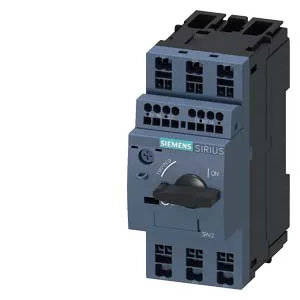
What this breaker does — and what the ratings mean for fit
The Siemens 3RV2011-1FA25 is a SIRIUS motor protection circuit breaker — a compact, DIN-rail-mounted device that combines a thermal-magnetic overload relay and a short-circuit trip in one housing, sized for motor branch circuits. The Trip Class 10 rating means it trips within 10 seconds at 7.2× the thermal setting, fast enough to protect standard induction motors from locked-rotor heating without nuisance tripping on normal starts. Phase failure detection is built in, so a lost phase on the line side will trip the breaker before the motor single-phases to failure. The interrupting ratings tell the real story for panel coordination: 100 kA at 400 V and 500 V, and 100 kA at 240 V — that is a high-fault-current rating that lets this breaker sit close to a large transformer or a high-capacity bus without needing a current-limiting fuse upstream. At 690 V the rating drops to 4 kA, which still covers most motor branch faults in 690 V systems, but if your fault current exceeds that, you will need a fuse or a larger upstream breaker for series coordination. Termination is via spring-loaded terminals on the main current circuit — no screw tightening, no torque check. The clamp accepts 2 × (0.5 … 2.5 mm²) solid or stranded, which covers most motor feeder cables up to about 2.5 mm² per phase. Mounting is screw or snap-on onto 35 mm DIN rail per DIN EN 60715, and the mounting position is any orientation, so panel layout is flexible.
DIN-rail fit and panel integration
The 3RV2011-1FA25 occupies a 45 mm wide footprint on the DIN rail, 106 mm tall, 97 mm deep. Clearance requirements: 50 mm above and below, 30 mm to the side for heat dissipation and arc venting. That is tight enough for a standard 600 mm wide enclosure to hold a dozen of these across a row, with room for a terminal block strip below. The spring terminals face forward, so gland-plate wiring is straightforward — strip 8 mm, push in, done.
