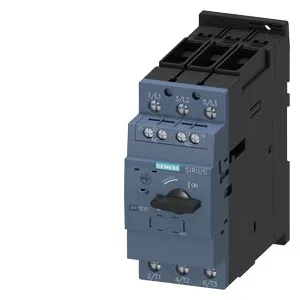
It's designed for motor protection, meaning it handles the inrush and running load of a three-phase motor and trips on a locked-rotor or fault condition before the motor windings cook. Rated breaking capacity hits 30 kA at 400 V AC — that's enough to clear a hard fault on most industrial distribution without the upstream breaker having to coordinate. Trip class is CLASS 10, so it disconnects within 10 seconds at seven times the thermal setting, fast enough for standard motor starts but not so fast it nuisance-trips on normal acceleration.
Dimensions are 149 mm deep, 55 mm wide, 140 mm tall; that 55 mm width is a single-module footprint on the rail, leaving room for the contactor and overload block alongside. Clearance requirements: 50 mm upward and downward, 10 mm at the sides. That upward gap matters if you're stacking breakers in a tight enclosure — the arc chute needs that space to vent hot gases. No forward clearance needed.
Main contact terminal size is M6 — takes 2x (0.5 to 1.5 mm²) solid or stranded, or 2x (0.75 to 2.5 mm²). Rated value spans 20 to 690 V. Breaking capacity varies with voltage: 100 kA at 240 V, 30 kA at 400 V, 5 kA at 500 V, 2 kA at 690 V. At 480 V it's rated 32 A continuous — that's the same current as the 600 V rating. The 30 kA at 400 V is the number most integrators will check first for a standard 400 V MCC.
That means it's still the active design, not a phase-out or NRND part.