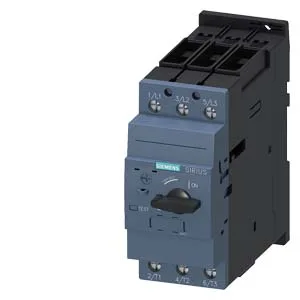
It provides overcurrent and short-circuit protection for three-phase motors, with integrated phase failure detection to trip on a lost phase — a common cause of motor burnout in field applications. Its Class 20 trip characteristic means it allows up to 20 seconds at 600% of the thermal setting before tripping, matching the starting profile of standard induction motors. This avoids nuisance tripping during startup while still protecting the motor from sustained overloads. Rated breaking capacity reaches 100 kA at 240 V, 30 kA at 400 V, 6 kA at 500 V, and 3 kA at 690 V — sufficient for most industrial distribution panels with high available fault current at the lower voltages.
Width is 55 mm. Depth of 149 mm and height of 140 mm. At 240 V no side clearance is required; at 400 V allow 100 mm above/below, at 500 V 80 mm, and at 690 V 63 mm — these distances are for arc-flash containment and must be observed in the panel layout. Main circuit terminals accept 2x 1–25 mm² or 1x 1–35 mm² solid or stranded copper, with M6 screw-type terminals. Wire the line side upstream of the contactor for proper coordination.
Environmental and operating limits
Operates at -20 to +60 °C; stores and transports at -50 to +80 °C. Rated for up to 15 switching operations per hour at AC-3 duty, which covers normal motor starting and stopping cycles. For higher cycling rates, derate or select a larger frame.