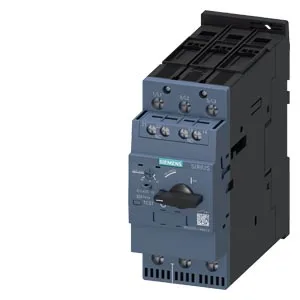
At 690 V it still handles 100 kA, and at 240 V it goes to 100 kA. It detects phase failure — if one phase drops out, the breaker trips, preventing single-phasing damage to the motor. It does not detect ground faults, so if ground-fault protection is required, you need an external ground-fault relay or a separate GFCI device upstream.
The breaker is rated for motor loads up to 52 A at 480 V and 52 A at 600 V, which corresponds to about 10 hp at 230 V. The auxiliary contact block handles 1 A at 24 V, 0.15 A at 60 V, and 0.5 A at 230 V — enough to signal a PLC input or a contactor coil, but not for direct motor switching. The main contact terminals accept M6 lugs, and the wire range is 2× (0.5 to 1.5 mm²) or 2× (0.75 to 2.5 mm²) solid or stranded. The dimensions are 149 mm deep, 55 mm wide, and 140 mm tall — that 55 mm width is a standard 3-module DIN-rail footprint, so it occupies three 18 mm slots on the rail. The maximum switching frequency is 15 operations per hour for AC-3 and AC-3e duty — that is about one start every four minutes, typical for motor starting but not for frequent jogging or inching applications.