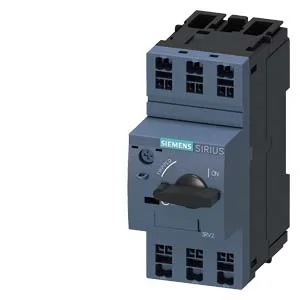
It's not a general-purpose motor protection breaker — the design tailors the trip curve to handle transformer inrush without nuisance tripping, while still providing short-circuit and overload protection for the primary side. Rated operating voltage spans 20 to 690 V. The breaking capacity sits at 100 kA at 400 V and holds that same 100 kA at 240 V, 500 V, and 690 V — that's a flat high-fault rating across the common industrial voltages, meaning you don't have to derate for higher-voltage panels. That's standard for motor circuits, but here it's applied to transformer primary protection — the fast trip still allows for the magnetizing inrush on energization.
Any mounting position is acceptable — horizontal, vertical, upside-down, doesn't matter for the thermal-magnetic trip. That's tight enough for dense panels. Dimensions: 45 mm wide, 106 mm tall, 97 mm deep. Main circuit connections use spring-loaded terminals — no screwdriver needed for the power wiring, just strip and push.
Environmental and operating limits
That's a wide storage range — fine for unheated warehouses or truck beds in winter. Maximum switching frequency at AC-3 duty: 15 operations per hour. That's not a high-cycling device — don't spec it for frequent switching applications like welding or rapid-start conveyors. It's meant for transformer primary protection where switching is infrequent.