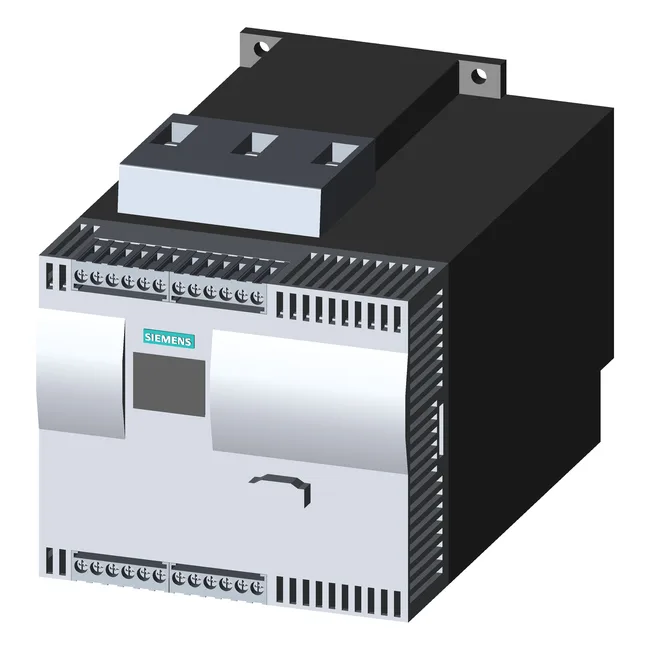
99 A at 40 °C — the real operating limit
The 3RW4425-1BC35: That 40 °C figure is the baseline — if your panel ambient runs hotter, the continuous current drops accordingly. Plan the enclosure ventilation around the 60 °C ceiling if the soft starter shares space with drives or transformers. The integrated bypass contact system means the thyristors only handle the start ramp; once at full speed, the bypass contactor carries the load current. This cuts the heat dissipation in the cabinet during run and extends the thyristor life — the bypass takes the thermal stress off the semiconductors.
Mounting and clearance — fits standard panels
Dimensions are 170 mm wide, 192 mm high, 270 mm deep. Screw fixing to the mounting surface. The mounting position allows vertical surface orientation with ±90° rotation and ±22.5° tilt front-to-back — useful when the panel layout forces an angled install. Clearance requirements: 100 mm above, 75 mm below, 5 mm at the sides. The 100 mm top gap is the critical one — that's the hot air exhaust path. Skimping on the top clearance derates the unit faster than the bottom gap.
Wiring and protection — what the terminals accept
Main current circuit uses box terminals accepting 2x (4... 50 mm²) stranded or 2x (10... 1/0 AWG) using both clamping points. That's a standard industrial terminal set — no special crimp tooling needed. Built-in motor overload protection and intrinsic device protection mean you don't need a separate overload relay in most installations. The adjustable current limitation lets you set the start current between 8% and the full rated current — useful for gentle starts on conveyors or pumps.
Inside-delta wiring and cable length
The 3RW4425-1BC35 supports inside-delta circuit wiring, which reduces the current through the soft starter to 58% of the motor FLA — effectively letting a 99 A unit control a motor drawing up to about 170 A line current. That's a common trick for larger motors where the soft starter cost scales with current rating. Maximum motor cable length is 500 m. Beyond that, the cable capacitance can cause nuisance tripping from leakage currents during the thyristor firing. For long cable runs, keep the total below 500 m or add an output reactor.
Pollution degree 3 per IEC 60947-4-2 — suitable for industrial environments with conductive dust or condensation.