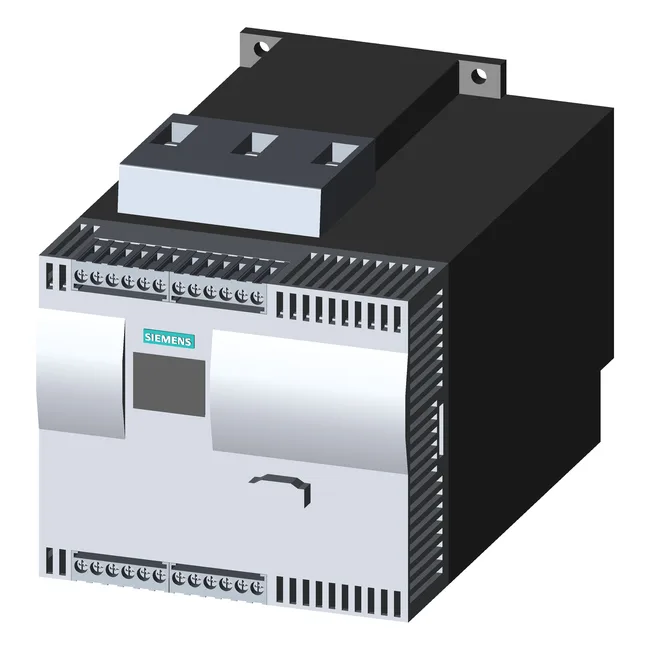
Thyristor soft starter with integrated bypass — 99 A at 40 °C
The 3RW4425-1BC36: It uses thyristor control for the starting ramp and integrates a bypass contactor that shorts the semiconductors after start, eliminating heat dissipation in the power section during run. The unit delivers 88 A at 50 °C and 78 A at 60 °C — the derating curve matters when the panel ambient runs above 40 °C. The minimum load threshold is 8 % of the rated current, so it handles lightly loaded motors without dropping out.
Current derating and thermal management in the panel
Rated current drops from 99 A at 40 °C to 88 A at 50 °C and 78 A at 60 °C — a 21 % reduction from the 40 °C baseline to the 60 °C ceiling. The derating temperature threshold is 40 °C; above that the output must be linearly reduced per the datasheet curve. Clearance requirements for natural convection cooling: 100 mm above, 75 mm below, and 5 mm at the sides. The mounting position allows vertical surface orientation with ±90° rotation and ±22.5° tilt forward/backward, which affects hot-air rise paths. The unit is fastened by screw fixing (not DIN-rail clip), so the panel backplate must have drilled and tapped mounting points matching the 170 mm width and 192 mm height footprint.
Wiring, protection, and control interface
The back and front clamping points accept 10... 2/0 AWG; using both clamping points accepts 2x (10... 1/0 AWG). Maximum motor cable length is 500 m. Motor overload protection is built in, with adjustable current limitation and intrinsic device protection. An external reset input is provided, and the fault signal is shown on an integrated display. Auxiliary contacts use 2x (20... 14) terminals. Pollution degree 3 per IEC 60947-4-2 means it tolerates conductive pollution in industrial environments. Ambient limits: -25 to +80 °C storage, 60 °C max during operation.
The inside-delta circuit wiring option is supported, which reduces the starter current rating by a factor of √3 compared to standard in-line connection — useful for retrofit into existing delta-wound motor circuits without changing the motor terminal box.