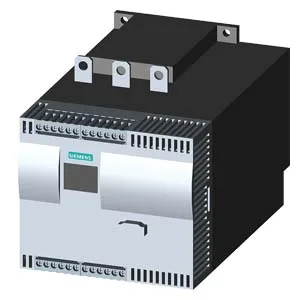
232 A at 40 °C — current derating and load matching
The 3RW4435-6BC46: The 40 °C figure is the reference — if your panel ambient runs higher, the continuous current drops linearly; budget the actual load against the derated value, not the headline number. Inside-delta wiring is supported, which lets the soft starter handle roughly 58% of the motor FLA compared to in-line connection — useful for retrofitting into a panel where the existing contactor and overload are staying in the main circuit. Minimum load is 8% of the rated current — below that the thyristor firing angle may not hold conduction. Verify the motor no-load current exceeds this threshold, especially on small or lightly coupled loads.
Panel footprint and wiring terminals
Dimensions are 170 mm wide, 200 mm high, 270 mm deep — the depth is the dimension that drives enclosure depth selection. Main circuit termination accepts stranded 25–120 mm² or busbar connection; auxiliary contacts take solid 0.5–2.5 mm² or finely stranded 16–95 mm². The main lug range covers 4–250 kcmil — common for the 232 A class. Clearance at the side is 5 mm; upward clearance 100 mm, downward 75 mm — respect these for airflow and cable bending radius.
Protection and control features
Built-in motor overload protection and intrinsic device protection are included — no separate overload relay needed for most applications. Adjustable current limitation lets you set the starting current between 0 and the rated value, which helps on generators or weak supply networks. External reset input is present, so the soft starter can be reset from a remote pushbutton or PLC output without opening the panel door. Fault signal is displayed on the unit — no separate display module required for basic diagnostics. Pollution degree 3 per IEC 60947-4-2 means it's rated for industrial environments with conductive pollution — no additional conformal coating needed in most panel conditions.
Insulation voltage rated 690 V, operating frequency 50/60 Hz, thyristor-based design. The maximum motor cable length is 500 m — beyond that, reflected wave effects on the motor winding should be evaluated.