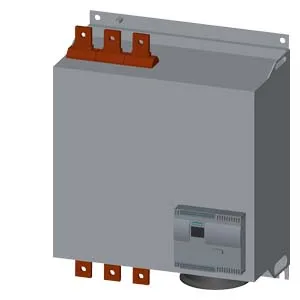
Sizing the 3RW4456-2BC45 for the motor load
An integrated bypass contact system switches the thyristors out of the circuit once the motor is at speed, eliminating conduction losses and reducing heat load on the enclosure — the bypass also extends thyristor life by keeping them cool during run. The inside-delta wiring option lets the starter connect inside the motor delta winding, reducing the current per thyristor to 58 % of the line current — this is the standard configuration for large motors and halves the thermal stress on the power stack.
Mounting and wiring — panel integration constraints
Mounting position allows vertical surface with ±90° rotation and ±22.5° tilt forward/backward — the starter can be oriented to fit tight panel layouts, but the derating curve assumes vertical orientation; horizontal mounting may require additional airflow. Fastening is by screw fixing to the mounting surface — the 510 mm width, 640 mm height, and 290 mm depth require a backplate large enough to clear the enclosure door and allow cable bending radius below the starter.
Protection and control features for the commissioning engineer
Motor overload protection and intrinsic device protection are built in — the starter monitors motor current and internal thyristor temperature, tripping on overload or overtemperature without an external relay. Adjustable current limitation lets the commissioning engineer set the starting current between 8 % and 100 % of the rated motor current — the minimum load threshold is 8 %, so the starter can handle lightly loaded motors without nuisance tripping. A display for fault signals and external reset input allow remote fault acknowledgement and local diagnostics — the motor brake output controls a DC injection brake directly from the starter, eliminating a separate brake controller.
Pollution degree 3 per IEC 60947-4-2 means the starter is rated for conductive pollution in industrial atmospheres — no additional conformal coating required for most panel environments.