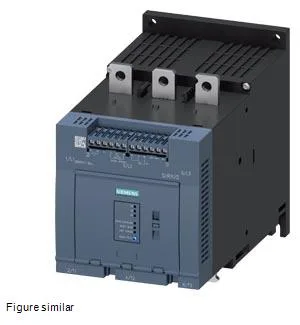
Rated current and trip class — what governs motor protection
The Siemens 3RW5075-6AB04 soft starter carries a minimum rated current of 160 A, setting the floor for the motor FLA it can manage. Trip class is selectable among CLASS 10A, 10E (preset), and 20E per IEC 60947-4-2 — meaning the overload protection curve matches the motor start profile: CLASS 10 for faster starts (centrifugal pumps, fans), CLASS 20 for higher-inertia loads (conveyors, crushers). The preset 10E is the default; if your application needs the longer acceleration window, you parameterize it to 20E.
Voltage range and fieldbus — panel integration constraints
Rated supply voltage spans 200 to 480 V, covering common global low-voltage three-phase networks (208 V, 230 V, 400 V, 480 V). Communication options are broad: Modbus RTU, Modbus TCP, EtherNet/IP, and PROFINET standard are all on board, plus PROFIBUS. That means the 3RW5075-6AB04 drops into a modern control architecture without a separate gateway — one Ethernet cable to the PLC handles parameterization, diagnostics, and the error logbook (the latter requires a special accessory). The analog output is configurable as 4-20 mA (default) or 0-10 V, settable via the High Feature HMI.
Environmental and mounting — enclosure planning
Mounting is screw fixing on a vertical surface, rotatable ±90° and tiltable ±22.5° forward/back. Clearance requirements: 100 mm upward, 75 mm downward, 10 mm forward, 0 mm backward, 5 mm at the sides. Shock resistance is 15 g / 11 ms, derated to 12 g / 11 ms if potential contact lifting is a concern. Dimensions: 230 mm high, 160 mm wide, 282 mm deep.
Hazardous-area certifications — ATEX, UKEX, IECEx
The 3RW5075-6AB04 carries ATEX, UKEX, and IECEx certification. That means it is approved for installation in potentially explosive atmospheres (gas and dust) per the respective directives — not just a general-purpose industrial soft starter. For a panel builder or MRO planner working in a Zone-classified environment (chemical, oil & gas, grain handling), this certification is the gatekeeper: without it, the starter cannot be specified. CE and UL/CSA approvals are also present, covering European and North American markets.