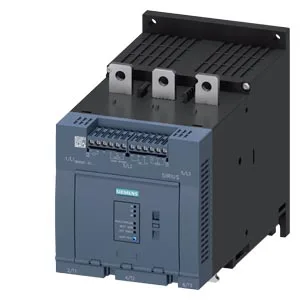
Hazardous-area motor starting
The 3RW5075-6TB04 carries ATEX, UKEX, and IECEx certification, meaning it can be wired into a motor branch circuit inside a Zone 1 or Zone 2 gas group enclosure without an additional galvanic isolator — the soft starter itself is the certified interface. Rated voltage covers 200 to 480 V, which spans the common 230/400/480 V three-phase supplies found across European and North American industrial plants. Minimum load is 160 A, so it fits motors in the 75–110 kW range depending on the service factor and duty cycle.
Trip class and starting method
Trip class is selectable between CLASS 10A, 10E (preset), and 20E per IEC 60947-4-2. CLASS 20E extends the thermal budget to 20 seconds, needed for high-inertia loads such as centrifuges or crushers where the start time exceeds 10 seconds. The unit supports both voltage ramp and soft torque starting profiles. Voltage ramp is the conventional method for most loads; soft torque applies a current-limited initial pulse to break static friction before the ramp begins, reducing mechanical shock on conveyors and gearboxes. Pump ramp down is built in — when the stop command is received, the output voltage decays gradually rather than cutting instantly, preventing fluid hammer in pipeline systems.
Fieldbus and network integration
The 3RW5075-6TB04 ships with PROFIBUS onboard and supports Modbus RTU, Modbus TCP, EtherNet/IP, and PROFINET standard via optional communication modules. This covers the four dominant industrial Ethernet protocols — Siemens S7 (PROFINET), Rockwell (EtherNet/IP), and any Modbus TCP controller — without a gateway. PROFIenergy is supported when used with the PROFINET communication module, allowing the drive to be put into energy-saving idle states during production pauses while remaining on the network.
Physical mounting and environmental limits
Mounting is by screw fixing onto a vertical surface; the unit can be rotated ±90° and tilted ±22.5° forward or backward, giving flexibility in tight enclosures where straight vertical mounting isn't possible. Clearance requirements: 100 mm above, 75 mm below, 10 mm in front, 5 mm at the sides, 0 mm behind — this keeps the cooling airflow path open. Shock resistance is 15 g for 11 ms, with potential contact lifting at 12 g — adequate for most industrial environments but marginal for high-vibration applications like crusher feeds.
Approvals and compliance documentation
CE marking covers the EU low-voltage and EMC directives. UL and CSA approvals are listed, so the unit is accepted in North American panels without a separate NRTL evaluation. ATEX, UKEX, and IECEx certificates cover explosive atmospheres — the specific certificate numbers and gas group ratings are on the Siemens documentation portal under the 3RW5075-6TB04 product page.