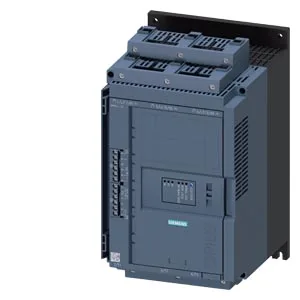
The 3RW5114-1XC14: For higher-inertia loads (centrifuges, crushers), switching to Class 20E gives a longer acceleration window before a trip. The unit supports both Voltage Ramp and Soft Torque starting profiles. Starting voltage is adjustable from 30-100 %; the stopping voltage is fixed at 50 %. Inside-delta connection is supported, which lets you size the soft starter for 58 % of the motor FLA when wired in the delta leg — a common panel trick to reduce unit cost on larger motors.
Fieldbus and HMI — no extra gateway needed
PROFIBUS DP, PROFINET IO, and Modbus RTU are all onboard — no external communication module required. The HMI-Standard and HMI-High Feature variants give you a local display for parameter readout and fault log access without a laptop. The analog output is configurable as 4-20 mA (default) or 0-10 V, so you can feed motor current or speed feedback straight to a PLC analog input or a panel meter.
Mounting and clearances for panel layout
Dimensions are 321 mm high, 185 mm wide, 203 mm deep. Mounting is by screw fixing; the unit can be tilted ±10° on a vertical surface. Minimum clearances around the unit: 100 mm above, 75 mm below, 10 mm in front, 5 mm at the sides, 0 mm at the rear. Plan the panel layout so the top vent isn't blocked by a busbar or another device.
Control wiring and diagnostics
Control connections use screw-type terminals — standard ferrule or ring-tongue. Remote reset is supported by cycling the control supply voltage off and on. The error logbook is stored internally, so when you power-cycle to clear a fault, the history stays. Auto-reset is also available if the application allows unattended restart after a trip.