Trip class and motor protection — the real starting duty
The 3RW5214-3TC05 ships with a default Trip Class 10A per IEC 60947-4-2, but can be set to 10E or 20E depending on the load's acceleration profile. Class 10A clears the start within 10 seconds at locked-rotor current — that's the right fit for centrifugal pumps and fans where the load drops off quickly. Class 20E buys you 20 seconds, useful for high-inertia loads like a long conveyor or a crusher that needs more time to spin up. The minimum settable current is 7.5 A, and the minimum load is 15% of that Ie setting. Below that floor the soft starter may not detect the motor correctly — size the unit so the motor FLA lands above 15% of the chosen current range.
Fieldbus mix — PROFIBUS, Modbus, and Ethernet on one unit
This generation of SIRIUS soft starter carries PROFIBUS, Modbus RTU, Modbus TCP, EtherNet/IP, and PROFINET on the same hardware — no need to swap a comms module when the plant migrates from PROFIBUS to PROFINET. The PROFINET implementation supports PROFIenergy, so the drive can signal the controller to shed loads during idle periods.
Mounting and panel fit — screw-fixed, not DIN-rail
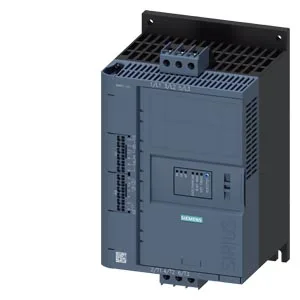
The 3RW5214-3TC05 uses screw fixing, not a DIN-rail snap — plan for four mounting points on the backplate. Dimensions are 275 mm high, 170 mm wide, 152 mm deep. Clearance requirements: 100 mm above, 75 mm below, 10 mm forward, 5 mm at the sides, and 0 mm behind the unit. The 0 mm rear clearance means it can sit flush against the panel backplane, but the forward gap is needed for the power wiring and fieldbus connectors. Mounting position allows +/-10° rotation and can be tilted forward or backward on a vertical surface — useful when the backplate is not perfectly plumb.
Wiring terminals — solid and stranded capacity
That covers most motor feeders up to about 25 A depending on the cable type. The control supply is 24 V DC — separate from the main power circuit, which keeps the logic alive during a fault condition.
Approvals and compliance documentation
The unit is classified under product category 'Hybrid switching devices' and carries a service factor of 1.0 — no continuous overload margin beyond the nameplate rating.