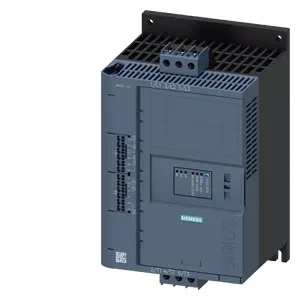
Trip class, voltage window, and what they govern
The 3RW5217-3TC14: Trip Class 10A (default), 10E, or 20E per IEC 60947-4-2. Class 10A means the starter disconnects within 10 seconds of a locked-rotor condition at 7.2× rated current — the right choice for standard induction motors that accelerate quickly. Rated operating voltage is 200-480 V AC, covering the common global low-voltage motor distribution: 200 V, 230 V, 400 V, and 480 V networks.
Fieldbus integration — PROFIBUS, Modbus, and industrial Ethernet
Onboard PROFIBUS DP and Modbus RTU (RS-485) are standard. Modbus TCP, EtherNet/IP, and PROFINET are supported via the PROFINET standard communication module, enabling direct connection to Siemens S7, Rockwell ControlLogix, and third-party PLCs without a gateway. PROFIenergy is available in connection with the PROFINET module, allowing the starter to coordinate energy-saving pauses with the controller during non-production intervals.
Mounting, clearances, and panel fit
Screw fixing (not DIN-rail snap-on). Dimensions: 275 mm height × 170 mm width × 152 mm depth. Minimum clearance around the unit: 100 mm above, 75 mm below, 10 mm forward, 5 mm at the sides, and 0 mm backward — essential for natural convection cooling. Mounting position: vertical surface with ±90° rotation and ±22.5° tilt forward/backward — allows panel orientation flexibility without derating, provided the clearance zones are respected.
Operating temperature and derating threshold
Ambient operating range is -25 °C to +60 °C, with a derating trigger at 40 °C and above. For continuous duty above 40 °C ambient, the output current must be reduced per the derating curve; at 60 °C the usable current is significantly lower than the nominal rating.
Application features — soft torque, pump ramp, and reset modes
Soft Torque and Pump Ramp Down are built in — the ramp-down profile reduces water hammer in pump systems by extending the deceleration time. Remote reset is supported by cycling the control supply voltage; auto-reset is also available.