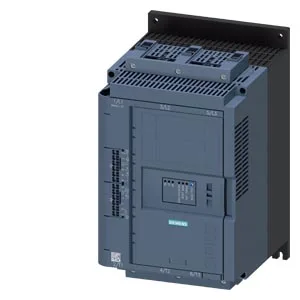
20 A minimum setting and trip class — what drives the motor start profile
The 3RW5224-3TC14's minimum settable current is 20 A, which defines the lower bound of the motor full-load current it can protect. For higher-inertia loads like centrifuges or crushers, select Class 10E or 20E via the parameter menu — the longer trip time gives the motor headroom to accelerate without nuisance tripping. This means the same unit works on 230 V, 400 V, and 480 V systems without a hardware change — only the parameter set adjusts.
Fieldbus portfolio — five protocols in one hardware variant
This order code ships with onboard PROFIBUS, Modbus RTU, Modbus TCP, EtherNet/IP, and PROFINET — no separate communication module purchase required. The PROFINET interface supports PROFIenergy, which allows the controller to put the starter into an energy-saving idle state during production pauses.
Mounting and clearance — screw-fixed, not DIN-rail
Fastening is by screw fixing — the unit does not snap onto a DIN rail. Plan for four M6 screws into a backplate rated for the 306 × 185 × 203 mm envelope. Minimum clearance requirements: 100 mm above, 75 mm below, 10 mm forward, 0 mm backward, and 5 mm at each side. These gaps are for ventilation and arc-flash containment; crowding them derates the continuous current.
Active production — no LTB, no obsolescence signal
No pin-compatible successor exists because none is needed.
Approvals and ambient derating for global installations
Carries CE, UL, and CSA marks — accepted in European, US, and Canadian installations without additional agency review. In a 50 °C panel, expect to reduce the motor full-load current setting proportionally per the derating curve.