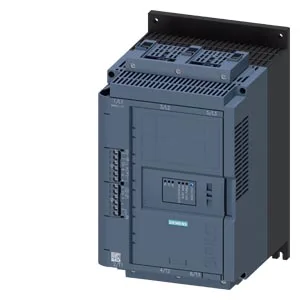
What this SIRIUS soft starter delivers on a motor line
The 3RW5227-1TC15 is a SIRIUS hybrid switching device — a soft starter that ramps motors up and down without the mechanical wear of a contactor across the full current range. Its minimum operating current is 40.5 A, so it is sized for motor loads that draw at least that at full load; the rated voltage span is 200... 600 V, covering standard low-voltage networks from 208 V to 600 V without a tap change. Trip class is selectable: CLASS 10A (default), 10E, or 20E per IEC 60947-4-2. That means the starter can be set to trip within 10 seconds (Class 10) or 20 seconds (Class 20) under locked-rotor conditions — a choice that matters when coordinating with upstream protection on a conveyor or pump start. The default 10A is the tightest; 20E gives more headroom for high-inertia loads. Soft torque and pump ramp down are built in — the starter can reduce starting torque for gentle load acceleration and ramp the motor down on stop to avoid water hammer in pumping applications. No external add-on module needed for that.
Fieldbus connectivity and control supply
This unit ships with onboard PROFIBUS, Modbus RTU, Modbus TCP, EtherNet/IP, and PROFINET standard — five fieldbus protocols, so it drops into most plant networks without a separate gateway. Remote reset is done by cycling the control supply voltage off then on — no separate reset signal wire needed. Auto-reset is also available if the application allows automatic restart after a fault clears. Firmware updates are supported over the fieldbus connection, which saves pulling the unit for a flash update on a production line.
Mounting, cooling, and panel fit
Fastening method is screw fixing — not DIN-rail snap-on — so the panel backplate needs drilled and tapped holes or threaded inserts. If the panel ambient hits 50 °C, the unit must be downrated per the curve. Physical envelope is 203 mm deep, 185 mm wide, 306 mm high — a substantial footprint. Clearance requirements: 100 mm upwards, 75 mm downwards, 10 mm forwards, 5 mm at the sides, 0 mm backwards. That means the unit can sit flush against the back panel but needs generous vertical air path above and below for convection cooling. Shock resistance is 15 g / 11 ms, with potential contact lifting at 12 g / 11 ms — so in high-vibration environments (near a press or crusher), the mounting structure should be stiff enough to keep acceleration below 12 g at the mounting points.
Compliance and approvals — what the nameplate carries
CE marking, UL approval, and CSA approval are all confirmed on this variant. That covers the European Low Voltage Directive, US and Canadian safety listings — so the unit can be specified into panels destined for North America or Europe without a separate agency review. The product category is hybrid switching devices, meaning it combines semiconductor switching for the ramp with a bypass contactor that closes at full speed — reducing heat dissipation during continuous run.