Trip class and motor protection — what 10A/10E/20E means for your start profile
The 3RW5234-2AC14 is configured with Trip Class 10A as default, with selectable 10E and 20E options per IEC 60947-4-2. If you're coordinating with upstream motor protection, match the trip class to the motor's thermal damage curve. A pump with a soft start profile rarely needs more than Class 10A; a crusher or conveyor with long acceleration time may need Class 20E to avoid a trip before the motor reaches full speed.
Fieldbus lineup — PROFIBUS, Modbus, EtherNet/IP, PROFINET
This soft starter natively supports PROFIBUS, Modbus RTU, Modbus TCP, EtherNet/IP, and PROFINET — no separate gateway module needed for any of these. That means you can drop it into a Siemens S7-1500 environment on PROFINET, or into a Rockwell CompactLogix rack on EtherNet/IP, and the I/O mapping is handled through the standard GSDML or EDS file. PROFIenergy is available when used with the PROFINET communication module — useful for energy management in automated lines where the soft starter needs to report power consumption during idle phases.
Panel fit — dimensions and mounting clearances
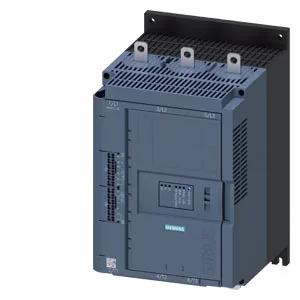
The 3RW5234-2AC14 measures 203 mm deep, 185 mm wide, and 306 mm high — screw fixing to the mounting plate, not DIN rail. Clearance requirements: 100 mm above, 75 mm below, 10 mm in front, 5 mm at the sides, and 0 mm behind. That 100 mm upward gap is non-negotiable for airflow — the soft starter's thyristor stack needs that space to dissipate heat, especially if you're running near the 53 A minimum. The shock resistance is 15 g for 11 ms, dropping to 12 g if contact lifting is a concern.
Active production and sourcing posture
CE, UL, and CSA approvals are on file — the UL mark covers the US market, CSA covers Canada, and CE covers the EU.