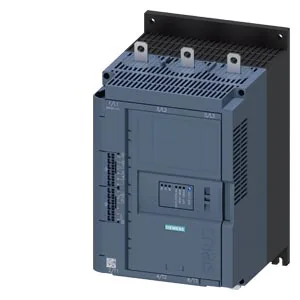
What this SIRIUS soft starter does that a contactor can't
The Siemens 3RW5234-2TC04 is a SIRIUS hybrid switching device — a soft starter, not a plain contactor. It ramps motor voltage up on start and down on stop, cutting the mechanical shock and current spike that a direct-on-line contactor slams into the load. Rated for a minimum load of 53 A at 200-480 V, it covers the sweet spot for medium motors — pumps, conveyors, fans — where you need controlled acceleration, not just an on-off switch. Trip class is configurable: default Class 10A, with options for 10E or 20E per IEC 60947-4-2. That means it can handle a 10-second or 20-second overload profile without nuisance tripping, depending on the motor's start-up draw.
Fieldbus and control — what talks to the PLC
This soft starter ships with onboard PROFIBUS, Modbus RTU, Modbus TCP, EtherNet/IP, and PROFINET standard — you don't need a separate communication module for most networks. PROFIenergy is supported when used with the PROFINET standard communication module. Control supply is 24 V DC. The unit supports remote reset by cycling the control supply voltage, plus automatic reset. No analog output on this variant. Firmware updates are possible in the field — useful if you're standardizing on a later parameter set across a line.
Mounting and panel fit — clearance counts
Screw fixing to the back panel, not DIN rail. Dimensions are 306 mm high, 185 mm wide, 203 mm deep — plan the gland plate and door clearance accordingly. Mounting position is flexible: vertical surface with +/-90° rotation, and +/-22.5° tilt forward/back. That helps when the panel layout is tight. Clearance requirements: 100 mm above, 75 mm below, 10 mm forward, 5 mm to the side, 0 mm backward. Side clearance is tight — adjacent devices can sit close, but the top and bottom need room for airflow and cable bend radius.
Environmental limits and approvals
Pollution degree 3 per IEC 60947-4-2 — suitable for industrial environments with conductive dust or condensation. Shock resistance is 15 g for 11 ms, with potential contact lifting above 12 g. That's typical for industrial panel mounting on a machine base. Approvals: UL, CSA, CE marking all present. Service factor is 1.0 — no built-in overload margin beyond the trip class setting.