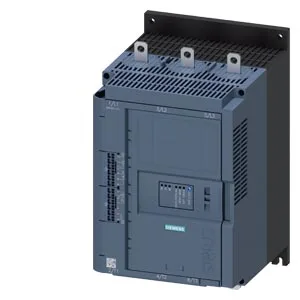
What the 81 A minimum current means for your motor start
The Siemens 3RW5236-2TC05 SIRIUS soft starter carries a minimum settable current of 81 A. That is the floor for the motor full-load current (FLC) you can program into the device — anything below that and the overload protection curve won't calibrate correctly. For a 400 V three-phase induction motor, 81 A corresponds roughly to a 45 kW output; the unit's rated voltage range of 200 to 600 V covers standard low-voltage supplies across global sites. Trip Class is configurable as CLASS 10A (default), 10E, or 20E per IEC 60947-4-2. Class 10A gives the fastest trip — suitable for pumps and fans that start unloaded — while Class 20E allows longer acceleration for high-inertia loads like centrifuges or crushers. The default 10A suits most general-purpose starts; switch to 20E only if the motor datasheet demands it.
Fieldbus connectivity: PROFIBUS, Modbus, EtherNet/IP, PROFINET
This soft starter ships with onboard support for PROFIBUS, Modbus RTU, Modbus TCP, EtherNet/IP, and PROFINET. That means it drops into most common automation architectures without an extra gateway — Siemens S7-1500 via PROFINET, Rockwell CompactLogix via EtherNet/IP, or legacy Modbus RTU on a twisted-pair line. PROFIenergy is available when used with the PROFINET communication module, allowing energy-management data collection during idle phases. The unit also supports firmware updates in the field, so protocol revisions or feature additions can be applied without replacing hardware. No analog output is fitted; process feedback relies on the digital fieldbus interface.
Mounting is by screw fixing to a vertical surface, with the unit rotatable ±90° and tiltable ±22.5° front-to-back. Clearance requirements: 100 mm above, 75 mm below, 10 mm forward, 5 mm at the sides, and 0 mm backward. Shock resistance is 15 g / 11 ms, dropping to 12 g / 11 ms if potential contact lifting is a concern.