Trip Class and motor protection coordination
The 3RW5244-6TC14 is configured with Trip Class 10A as default, with selectable 10E and 20E per IEC 60947-4-2. The minimum settable current is 100 A, meaning the soft starter cannot be dialed below that floor. If the connected motor's FLA is under 100 A, the 3RW5 family's smaller frame is the correct fit — this unit starts at 100 A and works upward.
Fieldbus integration — brownfield and greenfield
The 3RW5244-6TC14 ships with onboard PROFIBUS DP and PROFINET standard (with PROFIenergy support via the PROFINET communication module), plus Modbus RTU, Modbus TCP, and EtherNet/IP. That covers the three dominant industrial Ethernet protocols — no external gateway needed for a Siemens S7-1500 (PROFINET), a Rockwell CompactLogix (EtherNet/IP), or a Modbus TCP SCADA front-end. The PROFIBUS and PROFINET interfaces share the same physical port; the protocol is auto-detected at power-up. For Modbus RTU, the RS-485 termination and bias resistors must be set via the DIP switches on the front panel — the default is off, so a floating bus on first power-up will produce no communication.
Panel mounting and thermal derating
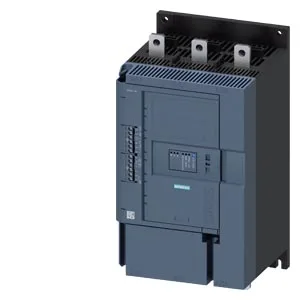
Mounting is screw-fixing only — no DIN-rail clip. The unit measures 393 mm high × 210 mm wide × 203 mm deep and requires 100 mm clearance above, 75 mm below, 10 mm in front, 5 mm at the sides, and 0 mm behind. The vertical mounting surface can be rotated ±90° or tilted ±22.5° front-to-back, which helps in tight enclosures where the backplane is not perfectly vertical. In a sealed enclosure with other heat sources (line reactor, bypass contactor), the internal temperature rise must be calculated — the soft starter's power semiconductors lose current capability roughly 1.5 % per °C above 40 °C. The shock rating is 15 g / 11 ms, dropping to 12 g / 11 ms if contact lifting is a concern.
Application profiles — pump ramp and soft torque
Soft Torque and Pump Ramp Down are built-in features. Soft Torque reduces the initial current spike on lightly loaded starts by applying a lower torque ramp — useful for conveyors with breakaway friction. Pump Ramp Down extends the deceleration ramp to prevent pressure surges (water hammer) on pump stop. These are parameter-selectable via the HMI or fieldbus; the default is standard ramp. Auto-reset and remote reset (by cycling the control supply voltage) are supported, which allows the starter to re-crank after a transient fault without a manual panel visit — common in remote pump stations. The error logbook is available only with the special accessory module; without it, the last fault code is held in volatile memory until power is cycled.
CE marked for EU low-voltage and EMC directives. UL and CSA approvals cover NAFTA installations — the UL file number should be verified against the specific end-use panel SCCR requirements. The service factor is 1.0, meaning no continuous overload margin beyond the nameplate FLA; any sustained overload must be handled by the upstream motor protection relay.