Motor current and trip class — what they mean for the line
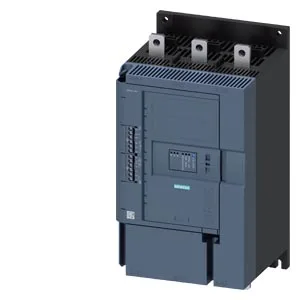
The 3RW5246-6AC04: The 160 A minimum setting (relative to the smallest settable Ie) means this soft starter is sized for motors drawing at least that current at full load — below that, the starting ramp may not engage the thyristor firing angle correctly, and the overload protection won't coordinate with the motor thermal curve. Trip class is selectable between CLASS 10A (default), 10E, or 20E per IEC 60947-4-2. The voltage range is 200–480 V, covering common global low-voltage networks (208 V, 230 V, 400 V, 480 V). Confirm the line voltage falls within this window — the soft starter's phase-angle firing control needs the full range to maintain torque linearity.
Mounting and panel fit — screw fixing with clearance rules
Screw fixing is the only fastening method — no DIN-rail clip. The unit measures 203 mm deep, 210 mm wide, and 393 mm high. Plan the backplate layout with these dimensions plus the required clearances: 100 mm upwards, 10 mm forwards, 0 mm backwards, 75 mm downwards, and 5 mm at the side. The 0 mm backwards clearance means the unit can sit flush against the back panel, but the 100 mm upward gap is mandatory for airflow and cable bending radius. Mounting position allows a vertical surface with ±90° rotation and ±22.5° tilt front-to-back.
Fieldbus connectivity and control features
Built-in fieldbus support includes PROFIBUS, Modbus RTU, Modbus TCP, EtherNet/IP, and PROFINET (with PROFINET standard communication module). This covers most common automation networks — no external gateway needed for integration into Siemens S7, Rockwell ControlLogix, or Modbus-based systems. Additional control features include soft torque for gentle starts on conveyors, pump ramp down to prevent water hammer, auto-reset and remote reset (by cycling the 24 V control supply), and an analog output configurable as 4–20 mA or 0–10 V via the High Feature HMI. The error logbook is available only with special accessories.
Lifecycle and compliance — active production, global approvals
Approvals include CE marking, UL approval, and CSA approval. Pollution degree 3 per IEC 60947-4-2 means it's rated for industrial environments with conductive pollution — no additional conformal coating required for typical panel conditions.