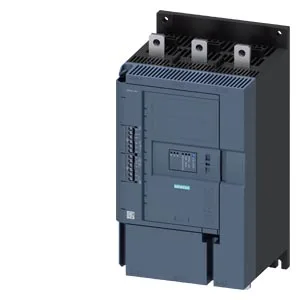
240 A minimum — the floor for motor sizing
The 3RW5248-6AC05 carries a 240 A minimum rated current, which sets the lower bound for motor full-load amps it can start. For a standard squirrel-cage motor at 400 V, that floor covers everything from about 110 kW up — but the real constraint is the trip class selection. Class 10E and 20E extend the thermal budget for higher-inertia loads such as centrifuges or crushers, where the start takes longer.
Voltage range and fieldbus — global panel fit
Rated 200-600 V, the unit covers 208 V through 575 V networks without a tap change — one SKU for North American 480 V and European 400 V installations. The wide range also absorbs line-side voltage sags common on weak grids. Fieldbus options include PROFIBUS, Modbus RTU, Modbus TCP, EtherNet/IP, and PROFINET. That covers most PLC ecosystems — Siemens S7, Rockwell ControlLogix, and Schneider M580 — without an external gateway. PROFIenergy support lets the starter coordinate with the controller during idle periods to shed load.
Ambient thermal limits — derating above 40 °C
In a hot mill or enclosed panel with other heat sources, the 240 A minimum may need to be reduced — the derating curve in the manual sets the actual ceiling. The 15 g / 11 ms shock resistance covers most industrial vibration profiles, including near rolling stands.
Mounting and enclosure clearance
Screw fixing, dimensions 393 mm high × 210 mm wide × 203 mm deep. Minimum clearance requirements: 100 mm above, 10 mm forward, 5 mm at the sides, 75 mm below — no clearance needed at the back. That 203 mm depth plus forward clearance means a 250 mm deep enclosure minimum for flush mounting. Mounting position is vertical surface, rotatable ±90° and tiltable ±22.5° front-to-back. That gives flexibility for tight panels but the derating note still applies — airflow direction changes with tilt.