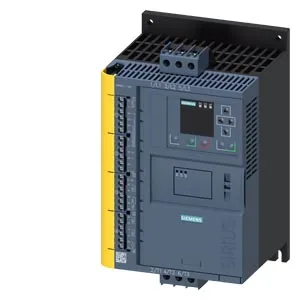
Application fit for motor starting and protection
This Siemens 3RW5513-1HF14 soft starter is designed for three-phase induction motors in the 200-480 V range, with trip class selectable between 10A, 10E, 20E, and 30E per IEC 60947-4-2 — the trip class determines how long the starter can sustain an overload before disconnecting, so 10A suits fast-starting loads like conveyors while 30E handles high-inertia loads like centrifuges. The ATEX and IECEx certification means it can be installed in Zone 1 or Zone 2 explosive atmospheres — the soft starter itself isn't the ignition source, but the motor circuit it controls may be in the hazardous area, and this unit provides the necessary isolation and protection. With UL and CSA approval, this unit meets North American code requirements for panel installations — no need for additional agency-listed external overload relays if the starter is used within its rated motor FLA.
Fieldbus integration and control interfaces
The 3RW5513-1HF14 supports PROFIBUS, Modbus RTU, Modbus TCP, and EtherNet/IP — this covers the majority of industrial Ethernet and serial fieldbus standards, so it drops into a Siemens S7 environment or a Rockwell ControlLogix network without a protocol gateway. The analog output can be configured as 4-20 mA or 0-10 V, providing motor current or torque feedback to a PLC or drive controller — useful for closed-loop torque control or pump applications where the ramp-down profile needs to match system pressure. A fail-safe input allows the soft starter to be wired into a safety circuit — when the safety relay opens, the starter goes to a safe state (open load circuit per), stopping the motor without relying on the fieldbus or PLC logic.
Motor control features for pump and torque applications
Voltage ramp provides a controlled acceleration profile — for pump starts this reduces water hammer, and for conveyor starts it limits mechanical shock to the belt and gearbox. Pump ramp down is a dedicated deceleration feature that matches the motor torque to the pump's head curve during stop, preventing pressure surges and pipe vibration that a simple coast-to-stop would cause. Torque control and DC braking give the starter the ability to hold or stop the load under controlled torque — DC braking is particularly useful for stopping high-inertia loads quickly without mechanical brake wear. The service factor of 1.15 means the starter can handle a motor running at 115% of its rated load continuously — this is common in pump and fan applications where the motor is selected with a service factor margin.
Mounting and clearance requirements
Dimensions are 152 mm deep, 170 mm wide, 275 mm high — the unit mounts on a backplate or DIN rail in a standard enclosure. Required clearances: 100 mm above, 10 mm in front, 75 mm below, 5 mm at the sides, and 0 mm behind.
Diagnostics and data logging
The starter includes an event list, error logbook, and trace function — these store the last several fault events with timestamps, which helps a technician diagnose intermittent trips without needing a separate data logger. Motor heating is monitored and modelled internally, allowing the starter to calculate thermal capacity usage and protect the motor from overheating even under repeated start cycles — this is a key feature for applications with frequent starts like crushers or punch presses. Accuracy class 5 per IEC 61557-12 means the current measurement is within ±5% — sufficient for overload protection and basic energy monitoring, but not for billing-grade metering.