ATEX and IECEx — what they mean for your installation
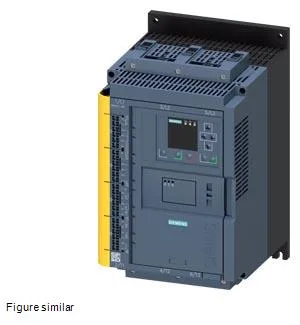
The 3RW5526-3HF04: This soft starter carries both ATEX and IECEx certification, meaning it is approved for installation in potentially explosive atmospheres under the ATEX Directive and the IECEx Scheme — a requirement for Zone 1 or Zone 2 gas environments and Zone 21 or Zone 22 dust environments when paired with an appropriately certified motor and enclosure. The ATEX and IECEx marks are not just paperwork — they signal that the internal components and enclosure gaps meet the ignition protection requirements of EN 60079-0 and EN 60079-7 (increased safety 'e') or EN 60079-15 (type of protection 'nA') depending on the variant. For a panel builder, this means the starter can be integrated into a certified Ex assembly without re-certifying the entire panel.
Trip class flexibility — matching the soft starter to the load profile
The trip class is selectable between CLASS 10A, 10E (default), 20E, and 30E per IEC 60947-4-2. CLASS 20E and 30E extend the thermal budget for high-inertia loads like centrifuges, crushers, or large fans that take longer to accelerate. Selecting a slower trip class (20E or 30E) allows the starter to ride through a longer acceleration without nuisance tripping, but the motor's thermal capacity must be checked — the starter's protection curve should sit below the motor's safe stall time at locked rotor current. The default 10E setting is appropriate for most pump and conveyor applications.
Voltage ramp, torque control, and breakaway pulse — starting modes for real loads
Voltage ramp start gradually increases the motor voltage from an initial level to full voltage over an adjustable ramp time, reducing mechanical shock on the driven equipment — useful for conveyors with belt tension issues or pumps where a sudden start causes pipe hammer. Torque control mode regulates motor torque directly, providing a constant acceleration torque regardless of load variations — ideal for loaded conveyors or mixers where the load changes during the start cycle. The breakaway pulse delivers a short high-torque burst at the beginning to overcome static friction (stiction) in sticky loads like crushers or screw feeders before the ramp takes over. Pump ramp down extends the deceleration time to eliminate water hammer on pump stop — the voltage is reduced gradually rather than cutting power abruptly, letting the pump slow naturally and avoiding pressure surges that damage piping and valves.
Fieldbus connectivity — Modbus RTU, Modbus TCP, EtherNet/IP, PROFIBUS
The soft starter supports Modbus RTU (RS-485), Modbus TCP (Ethernet), and EtherNet/IP natively, with PROFIBUS DP available as an option — covering the three most common industrial network protocols for PLC integration. This means it can be dropped into a Siemens S7-1500 system via PROFIBUS or into a Rockwell ControlLogix system via EtherNet/IP without a protocol gateway. The analog output is configurable as 4-20 mA or 0-10 V, providing a real-time signal proportional to motor current, torque, or power — useful for feeding a local panel meter or a PLC analog input module for trending and alarming.
DC braking and safe state — stopping and fault response
DC braking injects a DC current into the motor windings to produce a braking torque, stopping the motor faster than coast-to-stop — useful for high-inertia loads where rapid stopping is required for safety or process timing. The braking current and duration are parameterizable. The safe state on fault is an open load circuit — the soft starter opens the main contactor or thyristor gate to isolate the motor from the supply, ensuring a fail-safe condition. The unit supports auto-reset (configurable number of attempts) and remote reset via a digital input, allowing unattended restart after a cleared fault.
Physical integration — dimensions and clearances for panel layout
The enclosure measures 203 mm deep, 185 mm wide, and 306 mm high — a compact footprint for a soft starter in this current class. Required clearances: 100 mm above, 75 mm below, 10 mm in front, 5 mm at the sides, and 0 mm behind — the back can sit flush against the panel backplate. The screw terminal connection type is not used — this unit uses spring-cage or ring-lug terminals (check the specific variant). Plan for adequate bending radius on the incoming and outgoing power cables; the 185 mm width leaves room for side-by-side mounting with minimal gap.
Diagnostics and data — event log, trace function, error logbook
The event list and error logbook store the last several fault events with time stamps, helping a technician trace intermittent issues without needing a continuous connection. The trace function captures real-time data (current, voltage, torque) over a configurable window — useful for commissioning a tricky load or diagnosing a recurring trip. Firmware updates are supported in the field, so the unit can receive new features or bug fixes without being returned to the factory — the update is done via the communication interface using the Siemens SIRIUS Soft Starter ES software package.
Approvals and compliance — UL, CSA, CE, ATEX, IECEx
The soft starter carries UL and CSA approvals for North American installations, CE marking for the European market, and ATEX and IECEx certification for hazardous-area use. This combination covers the three major global regulatory frameworks — IEC (Europe/Asia), UL/CSA (North America), and Ex (hazardous locations) — so the same part number can be specified across multiple sites without re-qualification. The accuracy class is 5 based on IEC 61557-12, meaning the current and voltage measurement accuracy is within ±5% of reading — sufficient for motor protection and energy monitoring but not for revenue-grade metering. The service factor is 1.15, allowing the motor to run at 115% of rated load continuously without tripping when the ambient temperature is within limits.