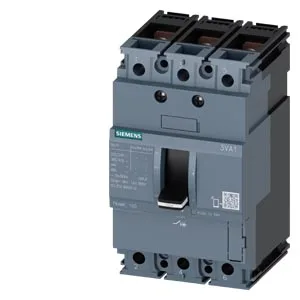
Breaking capacity runs 75.6 kA at 240 V, 52.5 kA at 415 V, 32 kA at 440 V, and 7.5 kA at 690 V. That SCCR headroom means it can sit upstream of a fault-hungry motor branch without worrying about cascading failure — the breaker clears a bolted fault before the arc has time to propagate to the bus.
Rated continuous current Iu holds at 100 A from 40 °C up through 50 °C ambient. It starts to derate at 55 °C (96 A), dropping to 90 A at 70 °C. If you're packing this into a hot enclosure — say a non-vented panel next to a drive — that derating curve matters. The 100 A rating is real at typical panel ambients, but you lose 10 A by the time you hit 70 °C inside the box. The 690 V breaking capacity is 7.5 kA — enough for most industrial 690 V distribution, but check your available fault current if you're on a high-capacity transformer. This version includes an undervoltage release (UVR) — part number 3VA9608-0BB11 — so if your control voltage drops, the breaker trips. That's a common spec for machinery safety circuits where a loss of control power needs to drop the main disconnect.
It's a DIN-rail-mounted MCCB — 76.2 mm wide (roughly 3 inches), 130 mm tall, 70 mm deep. No IP rating on the terminals themselves; they're live when the breaker is open, so standard finger-safe terminal shrouds are a good call if the panel gets opened hot.