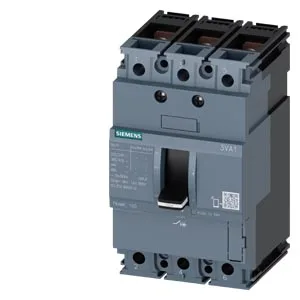
Breaking capacity runs from 121 kA at 240 V down to 11.9 kA at 690 V, so it's sized for high-fault commercial and industrial service entrances where the available fault current is substantial.
The 63 A continuous rating holds flat from 40 °C up to 50 °C, then derates to 60.48 A at 55 °C and 56.7 A at 70 °C. At 240 V it's rated for 121 kA; at 415 V it's 75.6 kA; at 440 V it's 52.5 kA; at 690 V it's 11.9 kA. For a 480 V delta service, interpolate between the 440 V and 690 V figures — you're looking at roughly 30–40 kA of interrupting capacity, which covers most industrial secondary distribution.
The 3VA1063-4ED32-0HA0 measures 130 mm high, 76.2 mm wide, and 70 mm deep. That 76.2 mm width is a standard 3-pole MCCB footprint — three modules at 25.4 mm each — so it drops into a panel busbar arrangement designed for that pitch.
Integrated shunt trip and auxiliary options
The shunt trip (STL) is built in, part number 3VA9688-0BL30 for the release itself. That lets you trip the breaker remotely from an E-stop, a PLC output, or a fire-alarm relay without adding an external undervoltage module. No auxiliary contacts are included — if you need status feedback (open/closed/tripped), you'll add a separate auxiliary switch block.