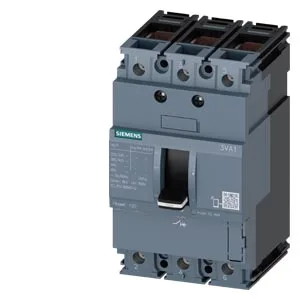
The TM210 thermal-magnetic trip unit provides a fixed thermal curve for overloads and a magnetic instantaneous pickup for short circuits; no ground-fault monitoring is built in (it is a 'Without' variant). The breaker carries a rated insulation voltage of 800 V, so it is comfortable on 480/277 V and 600 V systems, and its 121 kA interrupting rating at 240 VAC and 75.6 kA at 415 VAC give it the headroom to handle high-fault-current utility feeds without cascading upstream.
The 63 A rating holds flat from 40 °C through 50 °C — common panel ambient — then begins to step down: 62 A at 55 °C, 61 A at 60 °C, 60 A at 65 °C, and 58 A at 70 °C. Maximum power loss is 17.3 W, which is modest for a 63 A frame — heat dissipation in the panel is manageable.
Breaking capacity by voltage — selectivity planning
The interrupting ratings step down with system voltage: 121 kA at 240 VAC, 75.6 kA at 415 VAC, 52.5 kA at 440 VAC, and 11.9 kA at both 500 VAC and 690 VAC. On a 480 V system the 52.5 kA figure is the one to use for SCCR coordination; on a 690 V drive-fed bus the 11.9 kA rating still covers most industrial fault levels. The 3-pole design interrupts all phases simultaneously, which matters for three-phase motor circuits where a single-phase condition can damage windings.
Mounting and auxiliary switch integration
The breaker measures 76.2 mm wide, 130 mm tall, and 70 mm deep — a standard 3-pole MCCB footprint that bolts into a SENTRON distribution panel or a standalone enclosure. The auxiliary switches are wired to the breaker's internal mechanism, not the load terminals, so they report the breaker state even when the handle is manually opened.