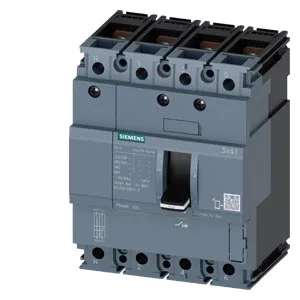
Siemens 3VA1063-4ED42-0KC0 — 63 A SENTRON MCCB with TM210 Release
Breaking capacity reaches 121 kA at 240 V AC, 75.6 kA at 415 V, 52.5 kA at 440 V, and 11.9 kA at 690 V — figures that govern selectivity coordination in a distribution board.
At 415 V the 75.6 kA still places it in the high-breaking category, suitable for most industrial distribution boards. Thermal derating is minimal up to 50 °C: the breaker holds 63 A flat. At 55 °C it derates to 60.48 A, at 60 °C to 59.22 A, at 65 °C to 57.96 A, and at 70 °C to 56.7 A. For a panel with internal temperature rise above 50 °C, size the upstream cable and load accordingly — the breaker itself will not trip falsely, but the continuous rating drops.
Mounting Dimensions and Panel Integration
The 3VA1063-4ED42-0KC0 measures 130 mm high, 101.6 mm wide, and 70 mm deep. The 101.6 mm width (4 inches) is the standard 4-pole MCCB footprint for a 63 A frame — it occupies four 25.4 mm module positions on a DIN rail or direct-panel mount. The 70 mm depth leaves clearance for rear-access wiring and busbar connections; verify the gland plate depth if the panel is shallow. The 15 000 mechanical endurance cycles are adequate for a distribution feeder that sees infrequent switching; for daily load-break duty, consider a contactor upstream.