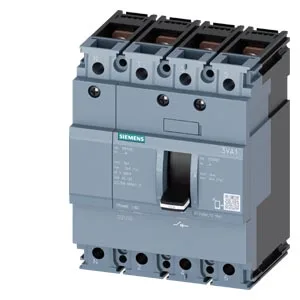
The Siemens SENTRON 3VA1110-1AA42-0AE0 is a 4-pole switch disconnector in a 3VA1 IEC frame 160 molded-case design — rated 100 A continuous current (Iu), with no overload or short-circuit protection built in. It's a pure isolating and switching device, not a circuit breaker. The part carries four HQ auxiliary switches for status feedback and uses busbar connection on the front terminals.
Rated continuous current Iu of 100 A sets the maximum load it can carry continuously without exceeding temperature limits. That 690 V AC rating covers most 400 V and 480 V industrial distribution, and the 600 V DC rating suits battery banks or DC bus switching up to that voltage. The 15 000 latching endurance cycles is the mechanical life for the switching mechanism — expect it to hold up for that many open-close operations under no-load or low-load conditions. Maximum power loss of 38 W is the heat it dissipates at rated current; factor that into enclosure ventilation if panel ambient runs warm. IP40 on the front means tools and wires over 1 mm diameter are kept out, but the enclosure must provide additional sealing if the panel sees washdown or dust.
The front terminal busbar connection is designed for horizontal busbar systems typical in distribution boards; the four auxiliary switches provide isolated contacts for status indication to a PLC or panel lamp. The optional motor drive allows remote switching if specified separately.