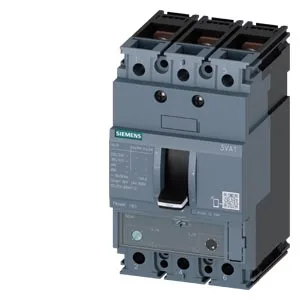
Siemens 3VA1110-4EF32-0AH0 — SENTRON MCCB, 100 A, Line Protection
Breaking capacity is the headline spec for this class. At 240 V AC, the 3VA1110-4EF32-0AH0 interrupts 121 kA symmetrical — that is a very high rating for a 100 A frame, suited for high-fault utility or transformer-fed service entrances. At 415 V it still clears 75.6 kA, and at 690 V it holds 11.9 kA. The 3-pole construction handles three-phase loads.
Thermal Derating and Ambient Operating Range
Above that, the continuous current must be reduced: 98 A at 55 °C, 96 A at 60 °C, 94 A at 65 °C, and 91 A at 70 °C. This is a standard thermal-magnetic characteristic — the bimetal element responds to both load current and enclosure ambient.
Physical Fit and Auxiliary Switching
Depth of 70 mm (2.76 in) fits within typical distribution cabinet clearances. This provides status feedback for the open/closed position and a separate signal for trip events — useful for remote monitoring or PLC inputs. No undervoltage release or shunt trip is included on this variant; those are separate accessories. A trip indicator is present on the front face, giving a visual flag when the breaker has opened on fault versus manual switching.