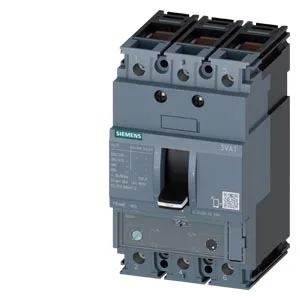
What this MCCB delivers on the line
The Siemens SENTRON 3VA1110-4EF36-0BC0 is a 3-pole molded case circuit breaker rated for 100 A continuous at 40 °C, with a breaking capacity of 121 kA at 240 V AC. That SCCR headroom means it can sit upstream of a distribution panel or motor control center and still clear a bolted fault without cascading — a key consideration for the site electrical engineer coordinating selectivity. The breaker is designed for line protection and includes an undervoltage release (UVR) plus two HQ auxiliary switches as standard. The UVR trips the breaker when supply voltage drops below a set threshold, which is useful for preventing motor re-acceleration after a dip. The auxiliary switches report status back to a PLC or HMI. Rated insulation voltage is 800 V, and the maximum power loss is 27.5 W — a figure the panel OEM wireman should check against enclosure thermal rise, especially in a sealed cabinet.
Dimensions and panel fit
The breaker measures 130 mm high, 76.2 mm wide, and 70 mm deep. The 70 mm depth is the dimension from the mounting surface to the front of the breaker — relevant for the panel builder checking gland-plate clearance or door-mounted component interference. Width at 76.2 mm fits a standard 3-pole MCCB footprint on a DIN rail or mounting plate.
Thermal derating and ambient limits
The breaker carries its full 100 A rating up to 50 °C ambient. Above that, it derates linearly: 98 A at 55 °C, 96 A at 60 °C, 94 A at 65 °C, and 91 A at 70 °C. Operating ambient range is -25 °C to 70 °C; storage range is -40 °C to 80 °C. For the commissioning engineer, the derating curve means the breaker can be installed in a warm enclosure without oversizing, as long as the actual load current stays below the derated value at the expected ambient.
Breaking capacity across voltage levels
The interrupting rating varies with system voltage: 121 kA at 240 V, 75.6 kA at 415 V, 52.5 kA at 440 V, and 11.9 kA at both 500 V and 690 V. The steep drop above 440 V is typical for MCCBs with this frame size — the 11.9 kA at 690 V still covers most industrial 690 V distribution, but the site engineer should verify the available fault current at the point of installation.
