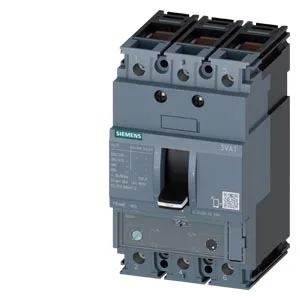
It is configured for line protection — no undervoltage release, no ground fault monitoring, no communication module. The front face carries a trip indicator and one auxiliary switch plus one trip alarm switch, which is the standard complement for remote status feedback on a feeder breaker. Breaking capacity is the headline spec here: 75.6 kA at 240 V, 52.5 kA at 415 V, 32 kA at 440 V, and 10.5 kA at 690 V. At 690 V the 10.5 kA figure is lower but still adequate for most motor control center applications where the upstream transformer limits fault current. Temperature derating is published across the full operating range: full 20 A rating holds through 50 °C, then drops to 19.2 A at 55 °C, 18.8 A at 60 °C, 18.4 A at 65 °C, and 18 A at 70 °C.
Front protection is IP40 — dust-protected but not sealed. Suitable for indoor panel mounting where no washdown or condensation is expected. The IP40 rating applies to the front face only; the rear terminals are not covered by that rating and require the enclosure's own IP protection. The latching endurance is 15,000 operations — that is the mechanical life before the latch mechanism wears. For a breaker that cycles infrequently (a few times a year for maintenance isolation), that is effectively a lifetime rating. For a breaker used as a daily disconnect, it is a finite count to track.
That means selectivity with downstream breakers depends on the natural time-current curve separation. For a simple radial feeder, it works fine. For a complex distribution with multiple levels of coordination, an electronic-trip 3VA variant (with adjustable I²t and short-time delay) would give more headroom. The auxiliary switch and trip alarm switch (1 each) are built in. The auxiliary switch follows the main contacts (open when breaker is open, closed when breaker is closed). The trip alarm switch changes state only on a fault trip — it stays in its normal position when the breaker is manually opened. That distinction matters for the PLC logic: use the trip alarm for a fault annunciation, not the auxiliary switch.