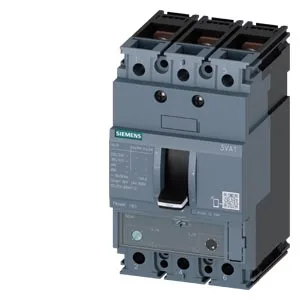
The Siemens SENTRON 3VA1120-5EF32-0CA0 is a 3-pole molded case circuit breaker rated for a continuous current of 20 A at 40 °C, with a TM240 thermal-magnetic overcurrent release. Its headline number is the interrupting capacity: 187 kA at 240 V AC, 121 kA at 415 V, and still 75.6 kA at 440 V — figures that put it squarely in the high-fault-current class for distribution panels and motor control centers. This is a line-protection breaker, not a motor-protection or ground-fault device. There is no phase-failure detection, no communication module, no auxiliary contact built in, and no voltage-trip trigger. The only integrated auxiliary release is an undervoltage release (UVR) — if the control voltage drops, the breaker opens. The unit is DIN-rail compatible (76.2 mm wide, 130 mm high, 70 mm deep) and drops into a standard 3-pole MCCB slot without special adapters.
Thermal derating — the real-world current you can pull
At 55 °C it derates to 19.2 A, at 60 °C to 18.8 A, at 65 °C to 18.4 A, and at 70 °C to 18 A.