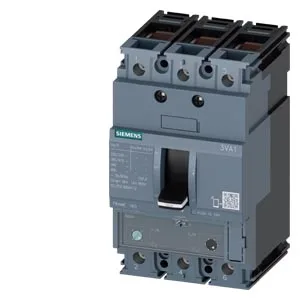
What this MCCB carries and where it fits
The Siemens 3VA1140-4EF36-0BH0 is a SENTRON molded case circuit breaker (MCCB) rated for line protection — not motor or generator duty — with a continuous current Iu of 40 A and a TM240 thermal-magnetic overcurrent release. The 3-pole frame breaks fault currents up to 121 kA at 240 V, 75.6 kA at 415 V, 52.5 kA at 440 V, and 11.9 kA at 690 V, which covers the interrupting range for most 400 V distribution panels feeding downstream sub-distribution or fixed loads. The 70 mm depth and 76.2 mm width fit the standard SENTRON 3VA panel footprint — same cutout and bus-bar spacing as the rest of the 3VA family — so it drops into an existing SENTRON-based distribution board without re-drilling the mounting plate or re-spacing the bus bars.
Thermal derating and ambient limits
The 40 A rating holds flat up to 50 °C ambient — no derating needed in a ventilated 35–40 °C panel. At 55 °C it steps to 38.4 A, and at 70 °C it reaches 36 A, a 10 % reduction from the nameplate. The TM240 release is calibrated for this curve; if the panel runs hot, size the upstream feeder for the derated value, not the 40 A label. Operating ambient spans -25 °C to 70 °C; storage extends from -40 °C to 80 °C. The IP40 front protection means the breaker face is splash-resistant but not hose-down rated — keep it inside the enclosure, not on the gland plate.
Auxiliary contacts and undervoltage release
This variant ships with an integrated undervoltage release (UVR) and a 2 aux + 1 trip alarm switch HQ auxiliary contact block. The UVR drops the breaker when control voltage falls below the dropout threshold — standard for emergency-stop circuits and undervoltage protection schemes where a loss of control power must open the main contacts. The trip alarm switch signals a fault trip separately from the aux contacts, which is useful for remote annunciation in a PLC input. The auxiliary trip module is order code 3VA9608-0BB11, a separate line item if the factory-fitted block ever needs replacement. No communication function, no phase-failure detection, and no ground-fault monitoring on this version — it is a straight thermal-magnetic breaker with UVR and aux contacts, nothing more.
