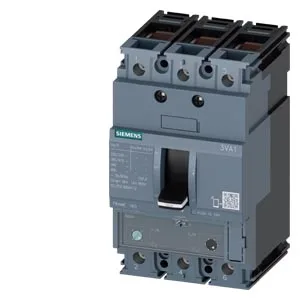
The 40 A rating holds flat from 40 °C through 50 °C, then derates to 38.4 A at 55 °C and 36 A at 70 °C, so for a panel that runs warm (say a 60 °C ambient), you're looking at 37.6 A continuous — still enough for a 40 A bus but worth checking if your load is already at the shoulder. The interrupting capacity is the headline: 121 kA at 240 V AC, 75.6 kA at 415 V, 52.5 kA at 440 V, and 11.9 kA at 690 V. For a 480 V panel (common in North American industrial), the 52.5 kA at 440 V is the closest published point — that's well above typical 18–25 kA available fault currents at a distribution panelboard, so you've got SCCR headroom for most downstream coordination studies. The 690 V figure (11.9 kA) is what matters if you're feeding a 600 V class motor control center.
That keeps the part simple and broadly interchangeable, but it also means you cannot field-upgrade to a communicating breaker. If your spec calls for power monitoring or remote status, this is not the variant.
That's a standard SENTRON 3VA1 frame size — it occupies the same panel footprint as other 3VA1 three-pole breakers in the 40 A range. Mounting is via the rear DIN rail clip or screw-mount adapter (not included); the IP40 front is rated for finger-safe operation inside a locked panel. If your maintenance team relies on a visual flag, factor that into the panel labeling.