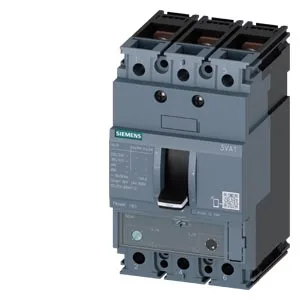
MCCB for high-fault line protection
Its TM240 thermal-magnetic release handles overload and short-circuit tripping without external power. The key spec here is the interrupting capacity: 220 kA at 240 V, 154 kA at 415 V, 121 kA at 440 V — that kind of headroom means it safely clears high-fault scenarios on the secondary side of a distribution transformer or near a large motor bank without cascading upstream breakers. The thermal derating curve is flat up to 50 °C (still 40 A), then drops to 39 A at 55 °C and 37 A at 70 °C. That matters for a sealed enclosure or high-ambient panel — you don't lose much headroom until the air inside hits 55 °C. Maximum power loss is 10.8 W, manageable in a standard IP54 cabinet without forced ventilation.
That 3-inch width per pole is standard for SENTRON 3VA frames in this rating class — it drops into the same DIN-rail or panel-mount cutout as other 3VA 40 A breakers.
What the breaking capacities mean for coordination
The 220 kA at 240 V is the headline number, but the real-world selectivity story is at 415 V (154 kA) and 440 V (121 kA). On a 400 V three-phase system, that 154 kA SCCR lets you place this MCCB downstream of a 1600 A main breaker without worrying about cascading failure during a bolted fault. The 17 kA rating at 690 V is still enough for most 690 V drives and motor circuits, but if your fault current exceeds that, you need an upstream current-limiting device.