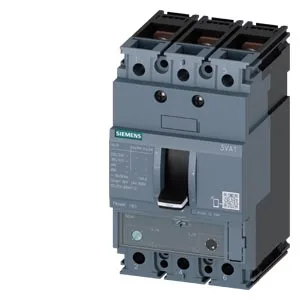
What this MCCB is and what it does
The Siemens 3VA1140-6EF32-0JC0 is a SENTRON molded case circuit breaker (MCCB) designed for line protection in distribution panels. It's a 3-pole unit rated 40 A continuous at 40 °C, with an interrupting capacity of 220 kA at 240 V AC — that's the fault it can safely clear without welding contacts or rupturing the case. The 800 V rated insulation voltage tells you it's built for 480 V and 600 V class systems with headroom. This variant ships with a shunt trip (STL) release and two HQ auxiliary switches integrated. The shunt trip lets a remote signal (emergency stop, fire alarm, PLC output) force the breaker open; the aux switches report position back to the control system. No undervoltage release, no ground-fault monitoring, no communication module — it's a straightforward line-protection MCCB with remote trip capability.
Ratings and what they mean for your panel
The interrupting ratings drop as voltage climbs: 220 kA at 240 V, 154 kA at 415 V, 121 kA at 440 V, and 17 kA at 500 V and 690 V. That 17 kA floor at 690 V is still respectable for most industrial secondary distribution — you'd only need a higher-rated upstream fuse if your available fault current exceeds that. The 40 A continuous rating holds steady from 40 °C to 50 °C, then derates to 37 A at 70 °C. If your panel ambient runs hot, plan for that 3 A derate. Dimensions are 130 mm high, 76.2 mm wide, 70 mm deep — standard 3-pole MCCB footprint for a 40 A frame. The 10.8 W maximum power loss matters for thermal budgeting inside a sealed enclosure; if you're packing multiple breakers in a small stainless box, that heat adds up. Operating temperature range is -25 °C to 70 °C, storage from -40 °C to 80 °C.
