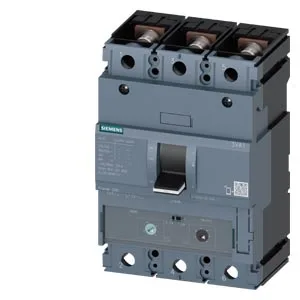
It carries a continuous current of 160 A at 40 °C, with a slight derating curve up to 70 °C (142 A at 70 °C). The interrupting capacity is 187 kA at 240 V AC, 121 kA at 415 V, 75.6 kA at 440 V, 30 kA at 500 V, and 17 kA at 690 V — these are the fault levels it can safely clear without welding or rupturing. That 187 kA at 240 V is the headline number, but the 121 kA at 415 V is what matters for most European 400 V panels — it gives you plenty of SCCR headroom for a 65 kA or 100 kA rated bus.
That means you get remote status indication (open/closed/tripped) without adding a separate accessory module — saves a DIN rail slot and a wiring step. The UVR drops the breaker if control voltage falls below its dropout threshold — standard for safety circuits where a loss of control power must open the main disconnect. No communication function on this variant; it's a standalone thermal-magnetic MCCB, not a metering or trip-unit-communicating version.
Physical footprint: 105 mm wide, 158 mm tall, 70 mm deep. If you're swapping out a 3VA1110-5EF32-0AM0, the bolt pattern and bus-bar spacing are identical; the only difference is the continuous current rating (160 A vs 100 A) and the trip unit settings.