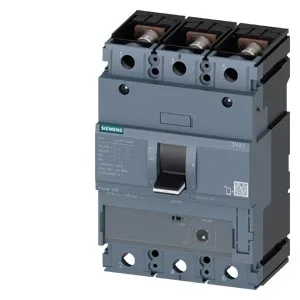
The 200 A frame carries the same rating from 40 °C through 50 °C (cites:,), then derates linearly to 176 A at 70 °C (cites:,), so the thermal curve matters if the panel ambient runs hot. Interrupting capacity reaches 187 kA at 240 V (cite:), 121 kA at 415 V (cite:), and 75.6 kA at 440 V (cite:) — numbers that govern whether this breaker coordinates with upstream gear or needs a current-limiting upstream device.
At 415 V the rating drops to 121 kA (cite:), at 440 V to 75.6 kA (cite:), at 500 V to 30 kA (cite:), and at 690 V to 4.5 kA (cite:). The steep roll-off above 500 V means this frame is not a 690 V main breaker for high-fault installations; at 690 V it is effectively a disconnect with modest fault handling. For a 480 V panel with available fault current under 75 kA, the 440 V rating is the relevant column — 75.6 kA gives headroom for most industrial distributions.
Panel fit and auxiliary configuration
The shunt trip allows a safety circuit or emergency-stop relay to open the breaker electrically, which is typical for starter-protection schemes where a downstream contactor failure must be isolated by the upstream MCCB.