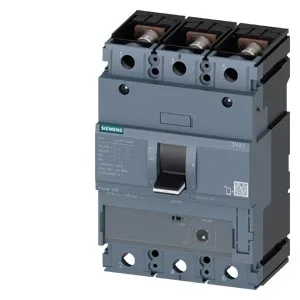
It's built for starter protection in motor branch circuits and general distribution panels — the kind of thing you'd find on a motor control center bucket or feeding a pump panel out in the grease. The 200 A frame carries a rated insulation voltage of 800 V, and the interrupting capacity runs from 187 kA at 240 V down to 4.5 kA at 690 V — so it handles high-fault utility feeds at 240 V but you'll need to check the available fault current at your service voltage. Continuous current is 200 A up to 50 °C ambient; above that it derates to 194 A at 55 °C, 188 A at 60 °C, 182 A at 65 °C, and 176 A at 70 °C. That's typical for a thermal-magnetic breaker — the bimetallic element responds to both current and ambient heat, so a hot panel eats into your headroom.
The 105 mm width and 70 mm depth fit standard SENTRON panelboard bus stacks and most 3-pole MCCB mounting plates. No special adapter needed for a DIN-rail enclosure — the breaker bolts directly to the bus or a backplate. In a sealed panel with other breakers, you'll want to check the cumulative heat rise against the 70 °C operating maximum. The shunt trip requires a separate control voltage — no backplane power.