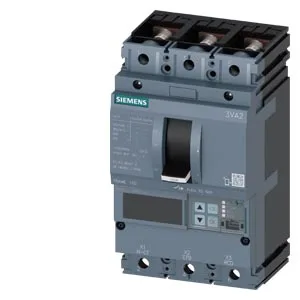
Breaking capacity drops with voltage: 121 kA at 440 V, 79 kA at 500 V, and 4.25 kA at 690 V. That 690 V figure is low enough that you need to verify coordination if the circuit operates near that voltage — the MCCB is still rated, but the margin tightens. Thermal derating is flat to 50 °C at 100 A, then steps down: 96.25 A at 55 °C, 92.5 A at 60 °C, 88.75 A at 65 °C, and 85 A at 70 °C. If the panel ambient runs at 60 °C, you lose 7.5 A of headroom — factor that into the load schedule.
Trip unit and auxiliary contacts
Fitted with an ETU560 electronic overcurrent release — that's the programmable, communicating trip unit in the SENTRON family, giving you adjustable LSI (long-time, short-time, instantaneous) protection curves plus ground-fault summation via the L-conductor. Communication function is built in, so it can talk to a higher-level monitoring system for trip data and status. That gives you two separate status signals (e.g., open/closed) and a dedicated alarm on trip — enough for remote indication without an external relay.
That 105 mm width is standard for a 3-pole SENTRON 3VA2 frame — it mounts on a DIN rail or panel-mount adapter, and the IP40 front face means it's protected against solid objects over 1 mm but not sealed against moisture.