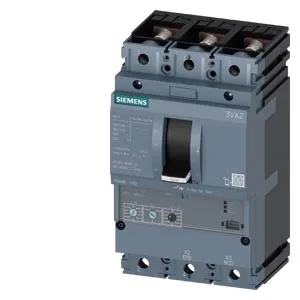
What this MCCB carries — and what that means for your panel
The Siemens SENTRON 3VA2110-5MN32-0AH0 is a 3-pole molded case circuit breaker (MCCB) rated for a continuous current Iu of 100 A, with an ETU350M electronic trip unit configured for motor protection. The 187 kA breaking capacity at 240 V tells you it can interrupt very high fault currents without upstream fuses — useful when the transformer is close or the SCCR requirement is stiff. At 415/440 V the interrupting rating is still 121 kA, dropping to 75.6 kA at 500 V and 17 kA at 690 V, so the voltage class of your distribution determines which figure governs your coordination study. The motor-protection designation means the ETU350M includes phase-failure detection, so a lost phase on a motor feeder trips the breaker rather than letting the motor single-phase and burn. The trip indicator on the front gives a clear visual when the breaker has opened on fault — no guessing whether it was a manual off or a trip event.
Thermal derating and the real-world current limit
The 100 A rating holds from 40 °C through 50 °C ambient. At 55 °C it derates to 96 A, at 60 °C to 94 A, and at 65 °C to 92 A, with a floor of 90 A at 70 °C. If your panel ambient runs above 50 °C — common in a packed enclosure or near a heat source — the usable current is the derated figure, not the nameplate 100 A. The maximum power loss is 75 W, which factors into the enclosure thermal calculation.
Physical fit and panel integration
Mounting dimensions: 105 mm wide, 181 mm high, 86 mm deep. That width is the standard 3-pole MCCB footprint for the 3VA frame size — it fits the same DIN-rail or screw-mount cutout as other 3VA breakers in this current class. The front IP40 rating means it is protected against tools and wires over 1 mm, which is typical for a panel-mounted breaker; no special sealing is needed inside a clean enclosure.
Auxiliary contacts and wiring
Factory-fitted with 2 auxiliary switches plus 1 trip alarm switch (HQ type). That gives you two form-C contacts for status feedback (open/closed) and a separate alarm contact that changes state only on a trip event — not on manual switching. The auxiliary release slot is empty (no shunt or undervoltage release fitted), so if you need remote tripping, that has to be added as a field-installable accessory.
