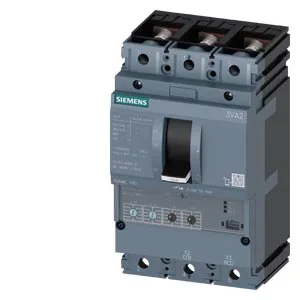
It carries a continuous current rating of 25 A across three poles, with an adjustable thermal-magnetic trip range from 38 A minimum up to 300 A maximum — that wide band lets you dial the long-time pickup to match the actual load without swapping the breaker frame. For a panel builder, the 86 mm depth and 105 mm width mean it fits the standard SENTRON 3VA2 footprint — no surprises when you lay out the DIN-rail or mounting-plate pattern.
Breaking capacity — the number that decides if it holds the unit on the grid
Rated short-circuit breaking capacity is 440 kA at 415 V and 187 kA at 690 V. That 440 kA figure at 415 V is what you need for high-fault installations — industrial substations, large motor control centers, or any point where the prospective short-circuit current runs north of 100 kA. The 690 V rating covers 600 V class systems common in North American and some marine applications. Provided that the upstream transformer impedance and cable run keep the available fault current within these limits, this breaker will interrupt a bolted fault without venting or welding its contacts — it holds the unit on the grid, not the other way around.
Thermal derating and operating envelope
The continuous current rating of 25 A holds flat from 40 °C through 70 °C ambient (–) — no derating curve to chase across the panel temperature rise. That is unusual for a compact MCCB; most frames start rolling back above 40 °C. The operating temperature range is -25 °C to 70 °C, with storage from -40 °C to 80 °C.