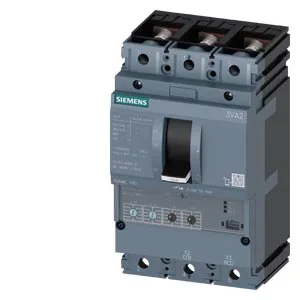
63 A MCCB with 242 kA interrupting — what the ratings mean for fit
The Siemens 3VA2163-6HM32-0AA0 is a SENTRON molded case circuit breaker (MCCB) rated for 63 A continuous current, 3-pole, designed for line protection. Its interrupting capacity hits 242 kA at 240 V AC — that's the fault current it can safely clear without welding contacts or rupturing the case. At 415 V and 440 V it still holds 187 kA, dropping to 121 kA at 500 V and 3.7 kA at 690 V. That 242 kA figure at 240 V means this breaker handles high-available-fault-current panels common in North American distribution — think service entrance or large feeder applications where the utility transformer can dump serious energy into a bolted fault. The 63 A rating holds flat across the entire operating temperature range from 40 °C to 70 °C — no derating needed as the panel warms up. That's unusual; many breakers start stepping down above 40 °C. Here, per the datasheet, the full 63 A is available all the way to 70 °C ambient. Insulation voltage is rated 800 V, so it's comfortable in 480/277 V or 600 V systems with margin. This variant includes summation-current ground-fault monitoring on the L-conductor path — it measures vector sum of phase currents to detect leakage to ground. No undervoltage release, no communication function, no trip indicator on the front. It's a straightforward line-protection MCCB with integral ground-fault sensing, suited for main or feeder breakers in distribution panels where ground-fault coordination is required.
Panel integration — dimensions and mounting
The breaker measures 105 mm wide, 181 mm tall, and 86 mm deep. That 86 mm depth is the dimension behind the panel face — critical for enclosure depth planning. It mounts on a standard DIN rail or can be bolted directly to a mounting plate. The 3-pole footprint matches the SENTRON 3VA2 family; if you're replacing an existing 3VA2 breaker, the bus-bar stab pattern and terminal spacing are consistent across the series.
Power loss and thermal management
Maximum power loss is 4 W at rated current. That's low enough that forced ventilation is unnecessary in most enclosures, but in a densely packed panel with multiple breakers at full load, cumulative heat should still be checked against the enclosure's dissipation rating.
