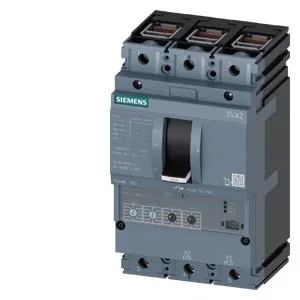
The Siemens SENTRON 3VA2163-6HN36-0CL0 is a 3-pole molded case circuit breaker rated for 63 A continuous current across the full 40 °C to 70 °C ambient range — no derating curve to chase up to that ceiling. The interrupting ratings climb to 242 kA at 240 V and still hold 187 kA at 415 V and 440 V, then drop to 121 kA at 500 V and 3.7 kA at 690 V (–). At 690 V the 3.7 kA figure is the ceiling; if your fault current at that voltage exceeds it, this breaker is not the right choice. The base switch core is order code 3VA2163-6HN36-0AA0.
It mounts into a standard SENTRON 3VA panel footprint — no special adapter plate needed. The width governs multi-breaker spacing in a distribution board; at 105 mm per pole set, three of these fill a 315 mm section. Depth at 86 mm leaves room for rear busbar connections without forcing a deeper enclosure.
The 242 kA interrupting capacity at 240 V is high enough for most secondary substations; the 187 kA at 415 V covers European 400 V distribution. At 690 V the 3.7 kA limit means this breaker is not suited for high-fault 690 V systems — that's where a higher-rated SENTRON variant would be needed. The power loss is 6.5 W maximum, low enough that ventilation requirements in the enclosure are minimal.