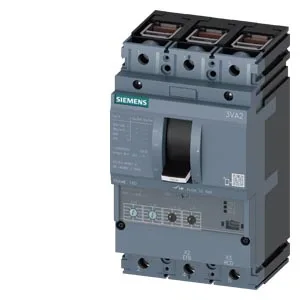
What this MCCB brings to a dusty control room
The Siemens SENTRON 3VA2163-6HN36-0DH0 is a 3-pole molded case circuit breaker rated for 63 A continuous current at 40 °C, with an ETU350 electronic trip unit and an integrated undervoltage release. It carries a 242 kA interrupting rating at 240 V, which drops to 187 kA at 415 V and 440 V, then to 121 kA at 500 V, and finally to 5 kA at 690 V — so the SCCR you need for your feeder panel depends entirely on the line voltage. It is a straightforward thermal-magnetic replacement with an electronic trip curve, built to sit in a main distribution board or a large MCC bucket where selectivity and high fault current are the concern, not fieldbus integration.
The 63 A rating holds flat from 40 °C to 50 °C, then derates to 60.6 A at 55 °C, 58.3 A at 60 °C, 55.9 A at 65 °C, and 53.6 A at 70 °C. Size the breaker for the actual load at the enclosure ambient, not the nameplate 63 A. The integrated undervoltage release (UVR) is factory-installed, part of the basic switch assembly 3VA2163-6HN36-0AA0, and the auxiliary trip module is 3VA9608-0BB25. If your safety circuit requires a shunt trip or a different UVR coil voltage, this variant is already set — verify the coil rating against your control voltage before wiring. Maximum power loss is 6.5 W — negligible for panel heat load calculations, but worth noting if you are packing dozens of these into a sealed enclosure.