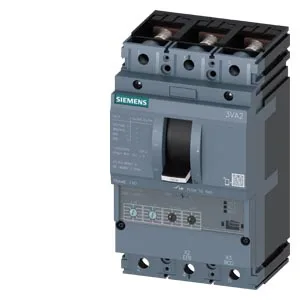
Siemens 3VA2163-7HN32-0HH0 — 63 A MCCB with ETU350 and 330 kA Interrupting Rating
The Siemens SENTRON 3VA2163-7HN32-0HH0 is a 3-pole molded case circuit breaker (MCCB) rated for 63 A continuous current, configured for line protection with an ETU350 electronic trip unit. Its interrupting capacity hits 330 kA at 240 V AC and 242 kA at 415 V AC — numbers that put it squarely in the high-fault-current class for industrial main feeders or large sub-distribution boards where the available fault current is substantial.
Breaking Capacity and Selectivity — What Those kA Ratings Mean for Your Panel
At 240 V the breaker clears 330 kA; at 415 V and 440 V it holds at 242 kA, and at 500 V it still manages 187 kA. Those are the short-circuit current levels it can safely interrupt without welding contacts or venting arc gas into the enclosure — critical for fault-ride-through coordination downstream. The sharp drop to 5.25 kA at 690 V tells you this frame is optimized for the 400–500 V range common in industrial distribution, not for 690 V motor circuits. If your BOM specifies 690 V service, this is not the variant for that rail.
Thermal Derating — 63 A Is Only Good to 50 °C Ambient
The 63 A rating holds flat from 40 °C through 50 °C ambient. Above that it steps down: 60.6375 A at 55 °C, 58.275 A at 60 °C, 55.9125 A at 65 °C, and 53.55 A at 70 °C. If this breaker sits in a non-ventilated enclosure near transformers or drives, the 55 °C derate may be the real continuous current limit you design to — not the nameplate 63 A.
Physical Fit and Panel Integration — 105 mm Wide, 181 mm Tall, 86 mm Deep
The breaker occupies 105 mm width, 181 mm height, and 86 mm depth — a standard 3-pole MCCB footprint. The 105 mm width is the critical dimension for multi-breaker grouping.
Environmental and Electrical Limits
Operating temperature range spans -25 °C to 70 °C; storage extends from -40 °C to 80 °C. Rated insulation voltage is 800 V, and the maximum power loss at rated current is 4 W — negligible for enclosure heat calculations but worth noting for tightly packed panels. The latching endurance is rated at 20 000 mechanical cycles, which governs the expected life under normal switching duty.
