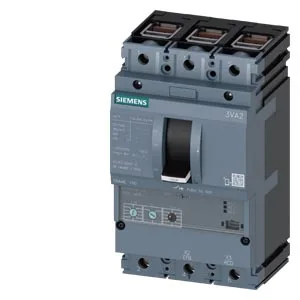
63 A MCCB for Motor Protection — SENTRON 3VA Series
The Siemens SENTRON 3VA2163-7MN36-0JC0 is a 3-pole molded case circuit breaker (MCCB) rated for a full 63 A across the entire 40 °C to 70 °C ambient range — no derating needed as the panel warms up, which is a real advantage in a crowded enclosure or a hot machine cell. The two HQ auxiliary switches give you status feedback for the PLC or a local indicator lamp.
It's a DIN-rail or screw-mount design; the 3-pole footprint matches the common 105 mm width for this class, so swapping in from an older 3VA or 3VL frame is straightforward.
For BOM freeze or compliance audits, the manufacturer provides RoHS and REACH declarations on request; UL and IEC certifications are standard for the SENTRON family.
That's unusual for an MCCB; most competitors start dropping current above 40 °C. In a sealed panel near a VFD or transformer, this saves you from oversizing to the next frame. The shunt trip release (STL) lets you wire a remote pushbutton or safety relay to trip the breaker without running a full-voltage coil circuit. The two HQ auxiliary switches are rated for control-circuit loads — one for the PLC input, one for a panel lamp or alarm.